Agricultural Interpreting Services in Oxnard, CA: Language Access for Farmworkers and Growers
Quick Summary
- Oxnard's farms and packing houses run on a multilingual workforce, and safety, onboarding, and workers' comp outcomes all depend on clear communication.
- Certified agricultural interpreting services in Oxnard, CA help growers meet Cal/OSHA training requirements, document injuries accurately, and keep crews working without costly miscommunication.
- On-site interpreters are typically the right call for field safety trainings and initial injury statements; remote/VRI works well for follow-up medical appointments and case check-ins.
- Workers' comp claims involving injured farmworkers move faster and hold up better when a certified interpreter — not a bilingual coworker — is in the room.
- Ortiz Schneider has supported California's agricultural and workers' comp interpreting standards for more than two decades, including advocacy work at the state level.
Table of Contents
- Why Agricultural Interpreting Services in Oxnard, CA Matter
- Ventura County's Agricultural Workforce
- Where Language Barriers Put Farm Operations at Risk
- Safety Training and Onboarding
- When an Injury Happens: Workers' Comp Claims
- On-Site vs. Remote Interpreting for Agricultural Employers
- Medical Interpreting, HIPAA, and Farmworker Health Screenings
- California's Legal Standards for Certified Interpreters
- Why Ortiz Schneider
- FAQs
Growers, packing houses, and ag-adjacent employers around Oxnard manage some of the most linguistically diverse crews in California, and that diversity is a strength — as long as instructions, safety warnings, and paperwork actually land. Agricultural interpreting services in Oxnard, CA give employers a reliable way to communicate with farmworkers in the language they understand best, whether that's Spanish, Mixtec, Zapotec, or another Indigenous Mexican language increasingly common in Ventura County fields. When that communication breaks down, the consequences show up fast: missed safety instructions, botched onboarding paperwork, and workers' comp claims that get harder to defend because nobody can say clearly what was actually communicated on the day of an injury.
Why Agricultural Interpreting Services in Oxnard, CA Matter
Oxnard sits at the center of the Oxnard Plain, one of California's most productive growing regions, known for strawberries, lemons, celery, and a long list of row crops harvested nearly year-round. That production schedule means a constant need for seasonal and year-round labor, much of it drawn from Spanish-speaking and Indigenous-language communities. A grower who treats interpreting as an afterthought is also treating safety compliance, injury documentation, and crew retention as afterthoughts, because all three depend on workers actually understanding what's being asked of them and being able to describe, in their own words, what happened when something goes wrong.
Professional agricultural interpreting services in Oxnard, CA are not the same as pulling a bilingual foreman off the line to translate. A certified interpreter is trained to render meaning accurately, without adding, omitting, or softening what either side says — a distinction that matters enormously once a safety incident becomes a workers' comp claim or a regulatory inquiry.
Ventura County's Agricultural Workforce
Ventura County's farm labor force includes a substantial share of workers whose first language is not English, and a growing number for whom Spanish is also a second language, layered on top of an Indigenous Mexican language such as Mixteco or Zapoteco. This "triple-language" reality is one reason a one-size-fits-all bilingual staff member often isn't enough. A crew of forty pickers might include workers who are fully fluent in Spanish, workers who understand spoken Spanish but read it poorly, and workers for whom Spanish itself is a second language they're still building. Agricultural employers who work with an interpreting partner that maintains a deep bench of language options are far better positioned to reach every worker on the crew, not just the majority.
Where Language Barriers Put Farm Operations at Risk
Language gaps on a farm rarely show up as a single dramatic failure. More often, they show up as small, compounding gaps: a pesticide re-entry interval that wasn't fully understood, an equipment safety briefing that was summarized rather than interpreted in full, or a new-hire packet signed without the worker understanding what they agreed to. Each of those gaps is a liability on its own. Together, they raise the odds of a Cal/OSHA citation, a workers' comp dispute, or a wage-and-hour complaint rooted in confusion rather than bad intent on either side.
The fix isn't more paperwork — it's better communication at the moments that matter most: hiring, safety training, and the immediate aftermath of any injury.
Safety Training and Onboarding: The First Line of Defense
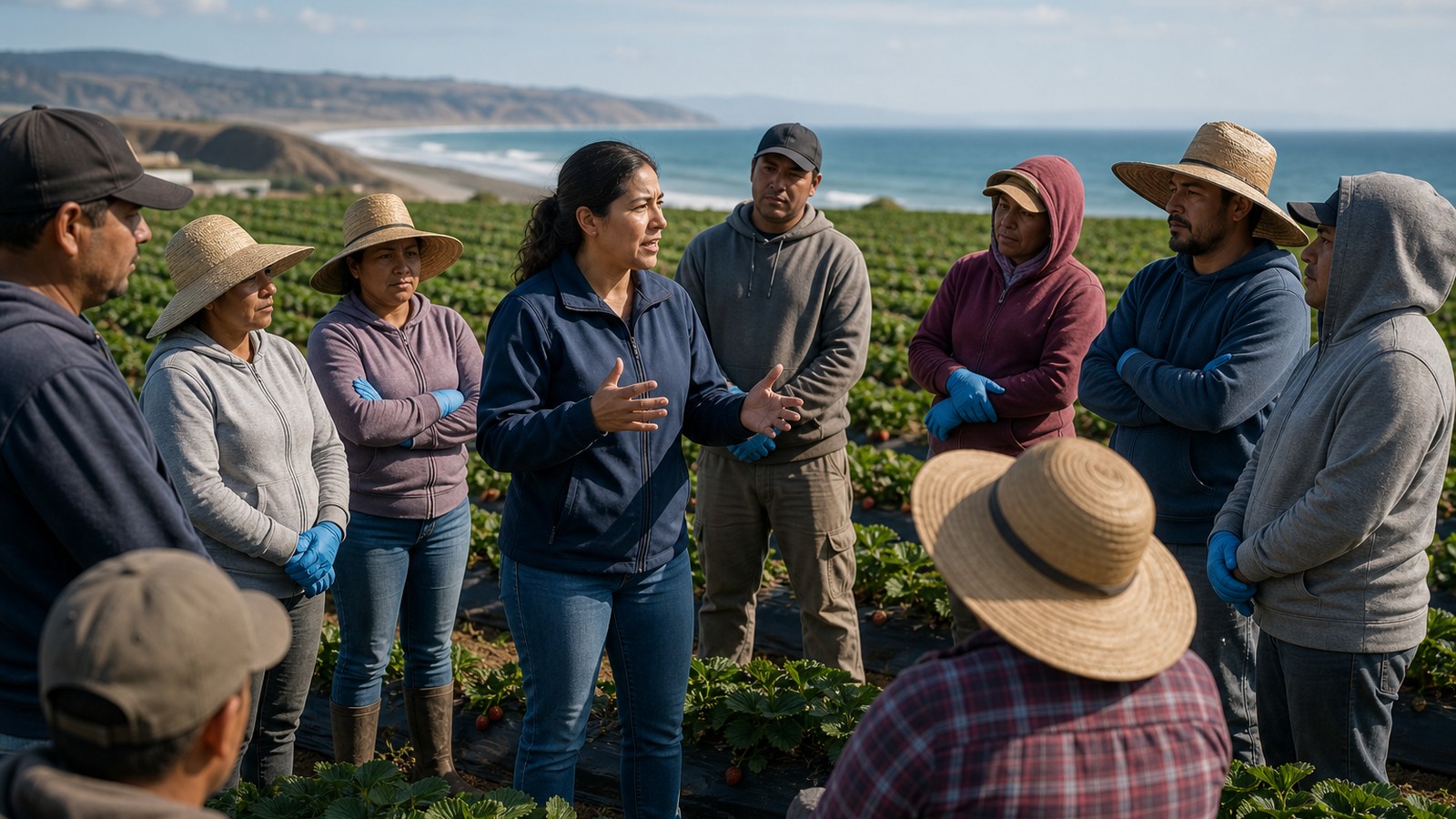
California's Heat Illness Prevention standard, pesticide safety training, and general Cal/OSHA requirements all assume workers actually understand what they're being told — not that a handout was distributed in a language some workers can read imperfectly. A live interpreter at new-hire orientation and seasonal safety refreshers lets workers ask questions in real time, which is often where the real understanding happens. Onboarding conducted through a qualified agricultural interpreter also gives employers a defensible record: everyone in the room received the same information, in a language they understood, with a professional interpreter present to confirm it.
For growers bringing on seasonal crews ahead of harvest, scheduling on-site interpreting for the first day or two of orientation is one of the highest-leverage safety investments available, and it typically costs far less than the aftermath of a preventable injury.
When an Injury Happens: Workers' Comp Claims and Certified Interpreters
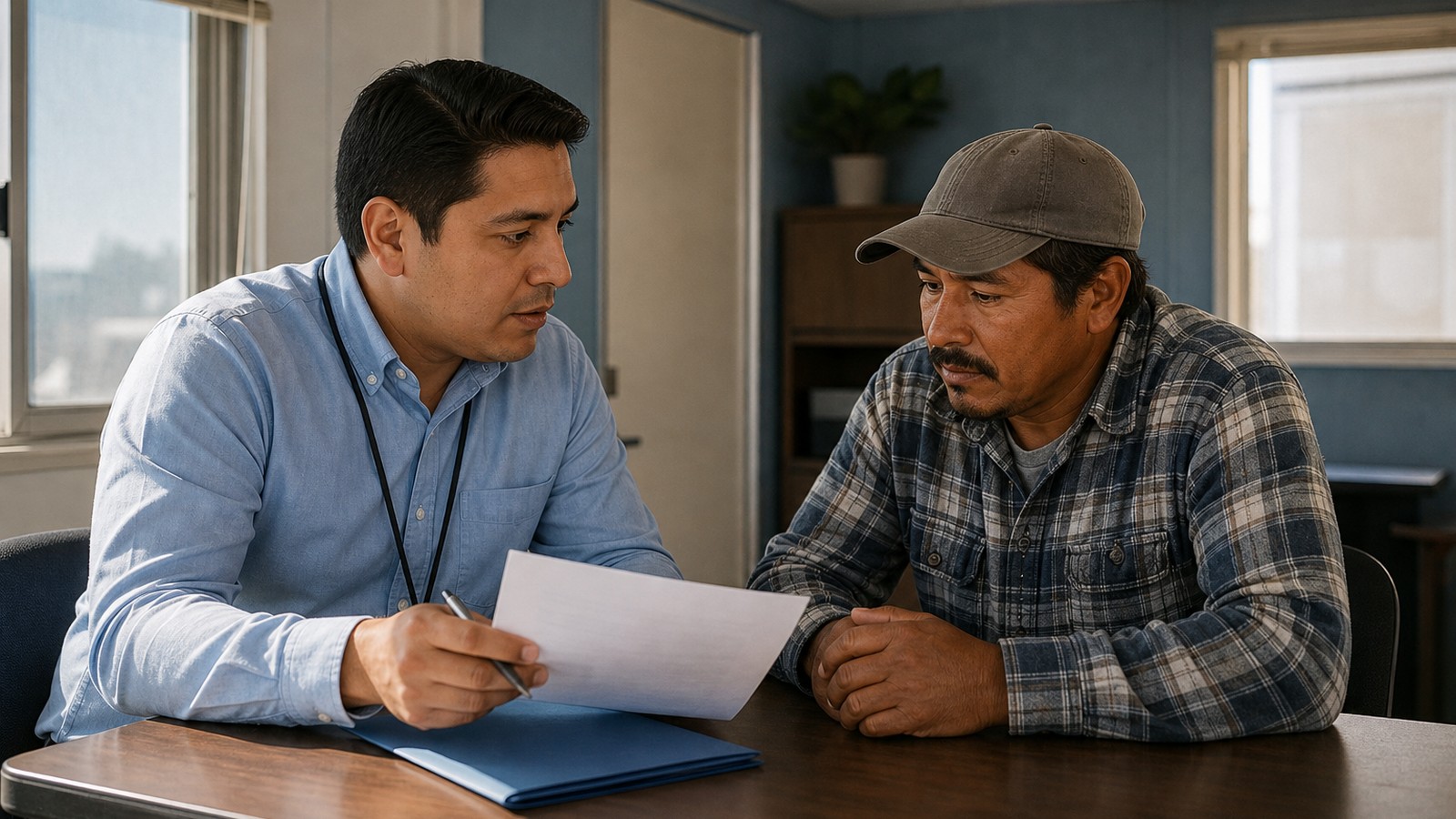
If an injury does occur, the interpreter present for the initial incident report, the first medical evaluation, and any recorded statement matters as much as the medical care itself. Insurers and defense attorneys will scrutinize how an injured worker's statement was obtained, and an uncertified, informal interpreter — a supervisor, a relative, a coworker — creates an opening to challenge the accuracy of that statement later. A certified interpreter creates a clean, defensible record from the first conversation forward.
This is also where Ortiz Schneider's roots in California workers' comp policy carry real weight for agricultural employers. The company's founder has worked directly with the California Department of Industrial Relations and state lawmakers on standards for workers' comp interpreting, so the interpreters staffed on agricultural WC claims are working within a framework built specifically for California's claims process — not a generic interpreting model borrowed from another state or industry.
On-Site vs. Remote Interpreting for Agricultural Employers
Not every situation calls for the same delivery method. On-site interpreting is generally the right choice for field safety trainings, new-crew orientation, equipment demonstrations, and the initial statement after an injury — situations where body language, physical demonstration, and being present in the field genuinely change the quality of communication. Remote and video remote interpreting (VRI) works well for scheduled medical follow-ups, adjuster check-ins, and administrative claim conversations, where a fast-connect professional interpreter can join by phone or video without anyone driving to a clinic or office. Many Oxnard-area employers use a blend: on-site for the field, remote for the paperwork and follow-up care that happens later.
Medical Interpreting, HIPAA, and Farmworker Health Screenings
Agricultural work brings farmworkers into regular contact with occupational health clinics — pre-placement physicals, heat-related illness evaluations, respirator fit testing, and post-injury treatment. Every one of those encounters is a medical conversation covered by HIPAA, which means the interpreter isn't just bridging language — they're also handling protected health information appropriately, from intake through discharge instructions. A worker who doesn't fully understand a diagnosis, a medication instruction, or a work-restriction note is a worker who is more likely to be re-injured or to return to a claim later with a dispute about what they were actually told. Pairing a certified medical interpreter with occupational health visits protects the worker and gives the employer and clinic a clean, HIPAA-compliant record of what was communicated.

California's Legal Standards for Certified Interpreters
California law recognizes the difference between someone who happens to speak two languages and a certified or credentialed interpreter trained for high-stakes settings. For workers' comp specifically, the interpreter's qualifications can directly affect whether a statement, deposition, or medical-legal evaluation holds up under review. Agricultural employers operating in Ventura County should expect — and ask for — interpreters who carry the appropriate state certification or credential for the setting, whether that's a medical evaluation, a legal proceeding, or a Cal/OSHA-related interview.
Why Ortiz Schneider
Ortiz Schneider Interpreting & Translation was founded in Santa Barbara in 1999 by Lorena Ortiz Schneider, a graduate of the Middlebury Institute of International Studies at Monterey with a master's degree in Translation and Conference Interpretation. Today the company delivers language solutions in more than 200 languages across California, with deep roots in exactly the fields this article covers: agriculture, workers' comp, and healthcare.
That expertise isn't just operational — it's shaped state policy. Lorena has chaired the Advocacy Committee of the California Workers' Compensation Interpreters Association, working directly with the California Department of Industrial Relations and state lawmakers to improve conditions and pay for WC interpreters statewide. She also founded CoPTIC (now CoPTIC America), which led the successful effort to secure language professionals an exemption from California's AB 5 gig-economy law, protecting the freelance interpreter model that keeps a deep, flexible bench of linguists available to employers across the state.
For Oxnard-area growers and agricultural employers, that means working with a partner whose standards were built inside California's actual workers' comp system, not adapted from somewhere else.
Frequently Asked Questions
Do agricultural employers in Oxnard need certified interpreters, or is a bilingual employee enough? A bilingual employee can help with everyday conversation, but for safety training documentation, injury statements, and workers' comp proceedings, a certified interpreter creates a more accurate and more defensible record. Informal interpreting by a coworker or supervisor can be challenged later if a claim is disputed.
What languages do Ventura County farmworkers typically need beyond Spanish? Many crews include workers who speak Indigenous Mexican languages such as Mixteco or Zapoteco as a first language, with Spanish as a second language. A qualified interpreting partner should be able to identify and staff for the specific language and dialect a worker actually speaks, not assume Spanish covers everyone.
Should safety training for seasonal crews use on-site or remote interpreting? On-site interpreting is generally best for initial safety orientation and hands-on equipment training, since it allows real-time questions and physical demonstration. Remote interpreting works well for shorter, scheduled follow-ups once the crew is already trained.
How does interpreting affect a workers' comp claim after a farm injury? The interpreter present for the initial injury report and medical evaluation shapes the official record of what the worker said happened. A certified interpreter reduces the risk that a claim gets challenged later over a disputed or unclear statement.
Does HIPAA apply to interpreting during a farmworker's medical evaluation? Yes. Any interpreted conversation during a medical visit — including occupational health screenings and post-injury treatment — involves protected health information, and the interpreter needs to handle that information according to HIPAA requirements.
Ready to Support Your Oxnard Crew?
Ortiz Schneider provides certified on-site interpreting and remote interpreting for California workers' comp claims, safety trainings, and medical evaluations, with dedicated support for employers in Oxnard and across Ventura County. Request a quote to schedule a certified agricultural interpreter for your next training, evaluation, or claim.