Deposition Interpreting in California: What to Expect and How to Prepare

Quick Summary
- Deposition interpreters in California must be certified or qualified — bilingual staff are not a substitute.
- Proper preparation, including pre-deposition glossary review, dramatically reduces transcript errors.
- Both on-site and VRI options are available; case complexity and location determine the best fit.
- Ortiz Schneider has provided certified deposition interpreting across California since 1999.
When a deposition involves a witness, plaintiff, or expert who does not communicate fluently in English, a certified interpreter is not optional — it is essential. In California, where workers' compensation cases, personal injury claims, business disputes, and immigration proceedings regularly involve Spanish, Tagalog, Vietnamese, Punjabi, Mandarin, and dozens of other languages, deposition interpreting is a daily reality for attorneys, claims administrators, and legal support professionals.
Yet many legal professionals — even experienced litigators — enter depositions with incomplete understanding of what a certified deposition interpreter does, what to expect during the session, and how to prepare for the best possible outcome. Errors at this stage can be costly: mistranslations, unfinished transcripts, objectionable testimony, and even case-dispositive problems can all stem from inadequate language support.
This guide walks through exactly what happens during a California deposition with an interpreter, what the interpreter's role is, how to prepare your client and your case, and how to choose a qualified language services provider for your next deposition.
What Is Deposition Interpreting?
Deposition interpreting is the practice of providing real-time oral language conversion between a witness or party and the attorneys and court reporter present at a deposition. In California, depositions are governed by the Code of Civil Procedure CCP §2025.010 et seq., and when a deponent does not understand or speak English, an interpreter must be present to ensure the record is accurate and the deponent can meaningfully participate.
Unlike simultaneous interpretation — where the interpreter speaks at the same time as the speaker, as in conference or courtroom settings — deposition interpreting is almost always consecutive interpretation. The speaker pauses after each sentence or phrase, and the interpreter renders the statement into the target language before the next utterance begins. This pause-and-interpret rhythm is slower than simultaneous, but it is more precise and far better suited to the official record produced by a court reporter.
The Interpreter's Role: Neutral Conduit
A professional interpreter at a deposition is a neutral conduit — not an advocate, not a cultural consultant, and not an aide to either party. The interpreter's sole function is to convert each statement as accurately and completely as possible from one language to the other, preserving the speaker's meaning, register, and even hesitations or ambiguities.
California courts and the legal community broadly expect interpreters to:
- Interpret everything said in the room — not just questions and answers, but attorney objections, colloquies, and clarifications
- Request clarification if a statement is unclear or too long to hold in memory
- Disclose any conflict of interest or prior relationship with any party
- Maintain strict confidentiality
- Avoid offering opinions, advice, or explanations beyond the interpretation itself
Attorneys sometimes assume the interpreter will “help” their client understand a complex question. That is not the interpreter's role. The interpreter renders the question faithfully — including its complexity. If the witness does not understand, that itself becomes part of the record.

California Deposition Interpreter Certification Requirements
Not everyone who speaks two languages is qualified to interpret at a California deposition. The state has established a tiered system of interpreter certification that applies across legal settings:
Certified Court Interpreters (CCI)
The California Judicial Council administers a rigorous certification examination for court interpreters. Passing this exam — which includes oral consecutive interpretation, sight translation, and simultaneous interpretation components — is the gold standard. As of 2025, Certified Court Interpreters are certified in Spanish and a small number of other languages including Cantonese, Japanese, Korean, Portuguese, Tagalog, and Vietnamese.
Registered Interpreters
For languages not covered by the CCI program, the Judicial Council offers a registration pathway. Registered interpreters must pass an English fluency test and an oral exam in the target language, though the bar is somewhat lower than for certified languages. In deposition practice, registered interpreters in less-common languages are standard and widely accepted.
Provisionally Qualified Interpreters
For rare languages where neither certified nor registered interpreters are available, a party may request a provisionally qualified interpreter, typically an individual with demonstrated bilingual competence and professional experience. This is a last resort and typically requires a court order or stipulation of counsel in litigation contexts.
For deposition practice specifically, California Evidence Code §755.5 mandates that in workers' compensation proceedings, a qualified interpreter must be used whenever a party or witness is not proficient in English. In civil depositions, the standard is grounded in CCP §2025.520, which allows any party to object to the qualifications of an interpreter.
Bottom line: If you are scheduling a deposition with a non-English-speaking witness, use a Certified Court Interpreter whenever possible. At Ortiz Schneider's legal interpreting practice, we work exclusively with certified and registered linguists — not bilingual employees or unvetted freelancers.
Before the Deposition: Preparation Is Everything
The quality of deposition interpretation is not determined solely by interpreter skill — it is heavily shaped by how well the session is prepared. Here is what experienced legal professionals do before the deposition begins:
1. Share Background Materials with Your Interpreter
If your case involves specialized terminology — a construction site injury, a complex medical diagnosis, a pharmaceutical liability claim — share relevant documents with your interpreter in advance. A brief glossary of industry-specific terms, or even the complaint and key exhibits, allows the interpreter to research and prepare the precise vocabulary before the session. A single ambiguous technical term — “distal radius fracture” vs. “wrist injury,” for example — can introduce inconsistency into the record.
At Ortiz Schneider, our interpreters receive case briefings for complex depositions as standard practice. We treat this as part of the engagement, not an add-on.
2. Brief Your Client or Witness
Non-English-speaking deponents are often unfamiliar with the deposition process. It is worth explaining — through the interpreter in a pre-session conversation — several key points:
- The interpreter will interpret everything said by everyone in the room
- The deponent should speak in natural-length sentences, not too long, and pause for the interpretation
- If the deponent does not understand a question, they should say so — not guess
- The deponent should listen to the full interpretation before answering
- The interpreter is neutral and does not represent any party
3. Decide: On-Site or Remote (VRI)?
One of the most consequential pre-deposition decisions is whether to use an in-person interpreter or video remote interpreting (VRI). Both are permissible at California depositions, but the choice matters:
For most complex litigation in Los Angeles, San Francisco, San Jose, and other major California metros, on-site interpreting remains the preference. For workers' compensation depositions in Fresno, Salinas, Bakersfield, or other Central Valley locations, VRI often delivers a faster, more flexible solution — especially for Spanish.
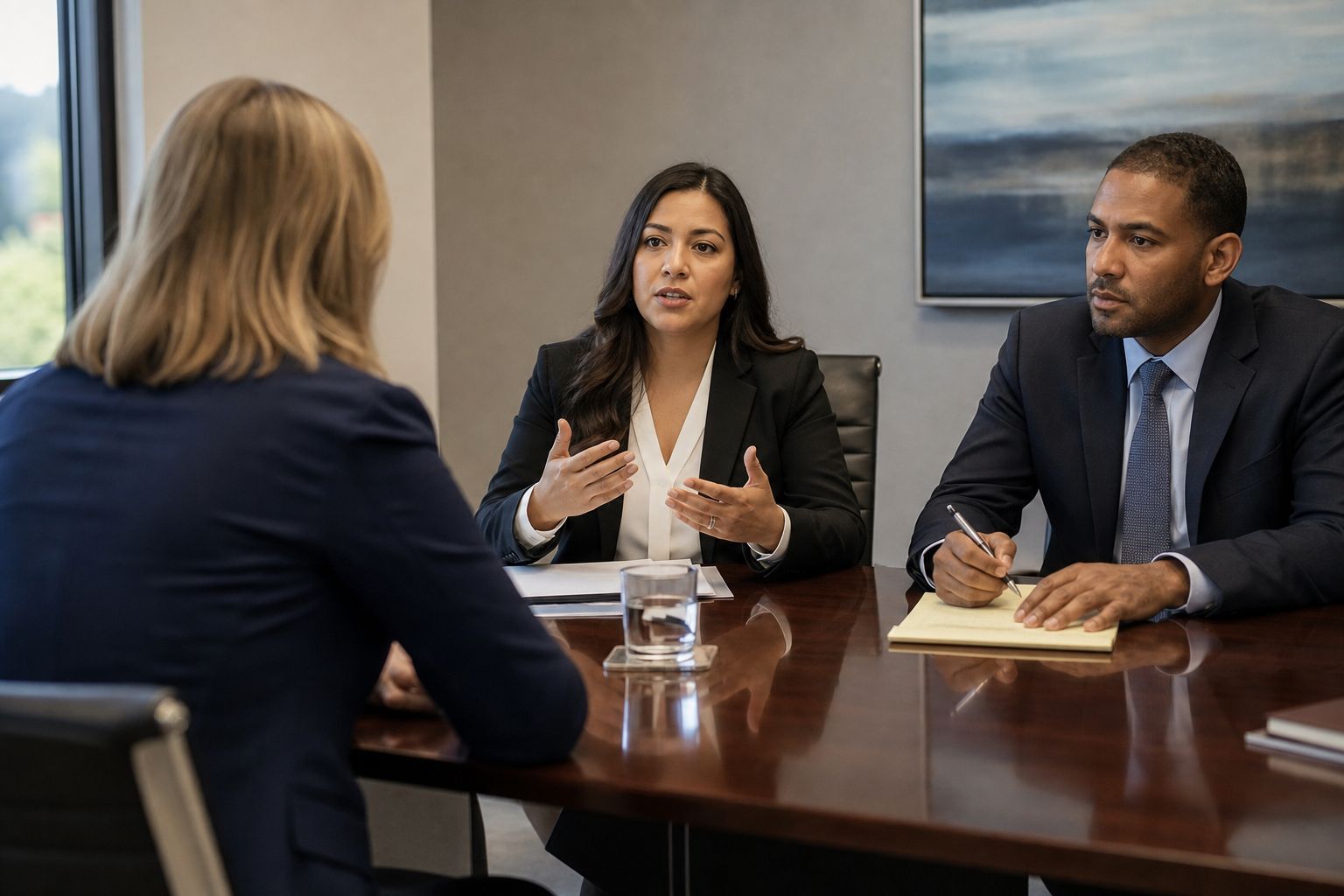
During the Deposition: What to Expect
The Opening: Swearing In the Interpreter
At the start of the deposition, the court reporter will swear in both the deponent and the interpreter. The interpreter takes an oath affirming that they will interpret accurately and impartially. This is standard procedure under California Evidence Code §751.
Rhythm and Pace
The most important adjustment for attorneys inexperienced with interpreted depositions is pace. You must speak in shorter segments — one question at a time, without compound sentences. Long, multi-clause questions, such as “Did you tell your supervisor about the pain in your back before or after the safety meeting in July, and was your foreman present at that point?” are difficult to interpret accurately and may need to be broken apart mid-stream.
Experienced deposition interpreters will signal when they need a pause — with a raised hand, a phrase like “Please allow me to interpret,” or a brief audible pause. Respect these signals; they exist to protect the accuracy of the record.
Handling Objections
Attorneys will object during the deposition, as usual. A common question is: should the interpreter interpret the objection for the deponent? Best practice — and the expectation of most California courts — is yes. The deponent should hear that an objection has been made, even if the legal significance is not explained. This keeps the deponent informed and avoids the appearance of coaching or withholding information.
Requesting Clarification or Repetition
A professional interpreter will ask the speaker to repeat or clarify when:
- The statement was too long to retain accurately
- A term is ambiguous or has multiple translations
- The speaker used an idiom or slang with no direct equivalent
- Background noise or poor audio in VRI made the statement unclear
This is not a sign of incompetence — it is professional diligence. An interpreter who never asks for clarification is more concerning than one who does.
Transcript Review
After the deposition, the court reporter's transcript will reflect the English-language statements. If the deponent made a statement in another language and the interpreter rendered it, the transcript reflects the interpretation. Attorneys may request a certified transcript, which can later be reviewed if disputes arise about the accuracy of interpretation. Having used a qualified interpreter from a reputable agency makes this review process far more straightforward.
Common Mistakes in California Deposition Interpreting
Even well-resourced legal teams make preventable mistakes with deposition interpreting. Here are the most common:
- Using a bilingual employee or family member. This is never appropriate for a legal deposition. Neutrality, certification, and professional accountability are non-negotiable.
- Failing to brief the interpreter in advance. Technical vocabulary preparation reduces errors dramatically.
- Speaking too quickly or using compound questions. Pace your questions for consecutive interpretation — shorter, cleaner segments.
- Assuming VRI is always sufficient. Complex cases, elderly deponents, or emotionally charged testimony may warrant in-person presence.
- Not confirming interpreter credentials before the session. Ask your language services provider for interpreter credentials in advance, especially for less-common languages.
- Booking last-minute. Certified court interpreters for Spanish and Tagalog in Los Angeles or San Francisco may have limited availability. For specialized languages, plan 5–7 business days ahead.
Languages Most Requested for California Depositions
California's linguistic diversity makes it one of the most demanding — and most experienced — markets for deposition interpreting in the United States. The most frequently requested languages for depositions handled by Ortiz Schneider include:
- Spanish — by far the highest volume, across all case types and all regions
- Tagalog / Filipino — high demand in Los Angeles, the Bay Area, and the Inland Empire
- Vietnamese — Orange County, San Jose, and the Sacramento Valley
- Mandarin and Cantonese — Bay Area, Los Angeles, and the San Gabriel Valley
- Punjabi — Central Valley agricultural regions, Fresno and Tulare counties
- Armenian — Glendale, Los Angeles, and the San Fernando Valley
- Korean — Los Angeles, Koreatown, and Orange County
- Russian / Ukrainian — Bay Area and Los Angeles
Ortiz Schneider supports 200+ languages and maintains vetted interpreter rosters for all major California markets — from San Diego and Los Angeles in the south to San Francisco and Sacramento in the north, and the Central Valley communities of Fresno, Salinas, and Visalia.
Frequently Asked Questions
Can opposing counsel object to the use of a particular interpreter?
Yes. Under California Code of Civil Procedure §2025.520, any party can raise an objection to the qualifications of a proposed interpreter. If the interpreter's credentials are in question, the deposition may be postponed or the interpreter replaced. Using a certified or registered court interpreter significantly reduces this risk.
Who pays for the deposition interpreter?
In civil depositions, the party noticing the deposition typically bears the cost of the interpreter. In workers' compensation proceedings, the WC carrier or claims administrator generally arranges and pays for interpreting services under California Labor Code §4600. In litigation, this can become a cost recovery issue — qualified interpreter invoices from a credentialed agency are far more defensible in cost-of-litigation arguments.
What if the interpreter makes a mistake during the deposition?
If an attorney believes a material error occurred, they can note the discrepancy on the record. With video depositions or recorded sessions, counsel can later compare the record to the original-language audio. This is one reason using a certified interpreter from a reputable agency matters: their work can be independently verified, and they carry professional liability for accuracy.
How far in advance should I book a deposition interpreter?
For Spanish, ideally 3–5 business days. For less common languages — Punjabi, Hmong, Arabic dialects, or uncommon Asian languages — 7–10 business days is prudent, especially in the Central Valley or less populated California regions. Ortiz Schneider accepts urgent same-day or next-day requests when availability allows, but advance booking ensures the best interpreter match for your case.
Is VRI accepted for all types of California depositions?
VRI is generally accepted for civil and workers' compensation depositions in California, particularly after 2020 when remote depositions became standard practice. However, some complex or contested depositions, especially those involving elderly, hearing-impaired, or traumatized witnesses, benefit from in-person presence. Consult with your language services provider to assess the best option for each specific case.
Working with Ortiz Schneider for California Deposition Interpreting
Since 1999, Ortiz Schneider's legal interpreting team has supported California attorneys, law firms, insurance carriers, and third-party administrators with certified deposition interpreting statewide. Our interpreters are:
- Certified or registered by the California Judicial Council
- Experienced across civil litigation, workers' compensation, personal injury, and employment law depositions
- Available on-site across Los Angeles, San Francisco, San Jose, Fresno, Salinas, Santa Barbara, and the Central Valley
- Available via VRI for statewide and nationwide coverage
- Bound by strict confidentiality and impartiality requirements
We provide pre-deposition glossary review as standard, assign interpreters with relevant subject matter experience, and offer bilingual legal support staff to assist with scheduling, credentialing documentation, and post-session questions.
Whether your next deposition is in a Wilshire Boulevard law office, a Fresno WC panel hearing room, or via videoconference from anywhere in California, Ortiz Schneider has the certified linguists and the operational experience to support your team.
Ready to schedule your next California deposition interpreter? Request a quote from Ortiz Schneider or contact our team today. We'll match your case with a certified interpreter in your language, your location, and your timeline.