How to Hire a Certified Court Interpreter in California: A Step-by-Step Guide
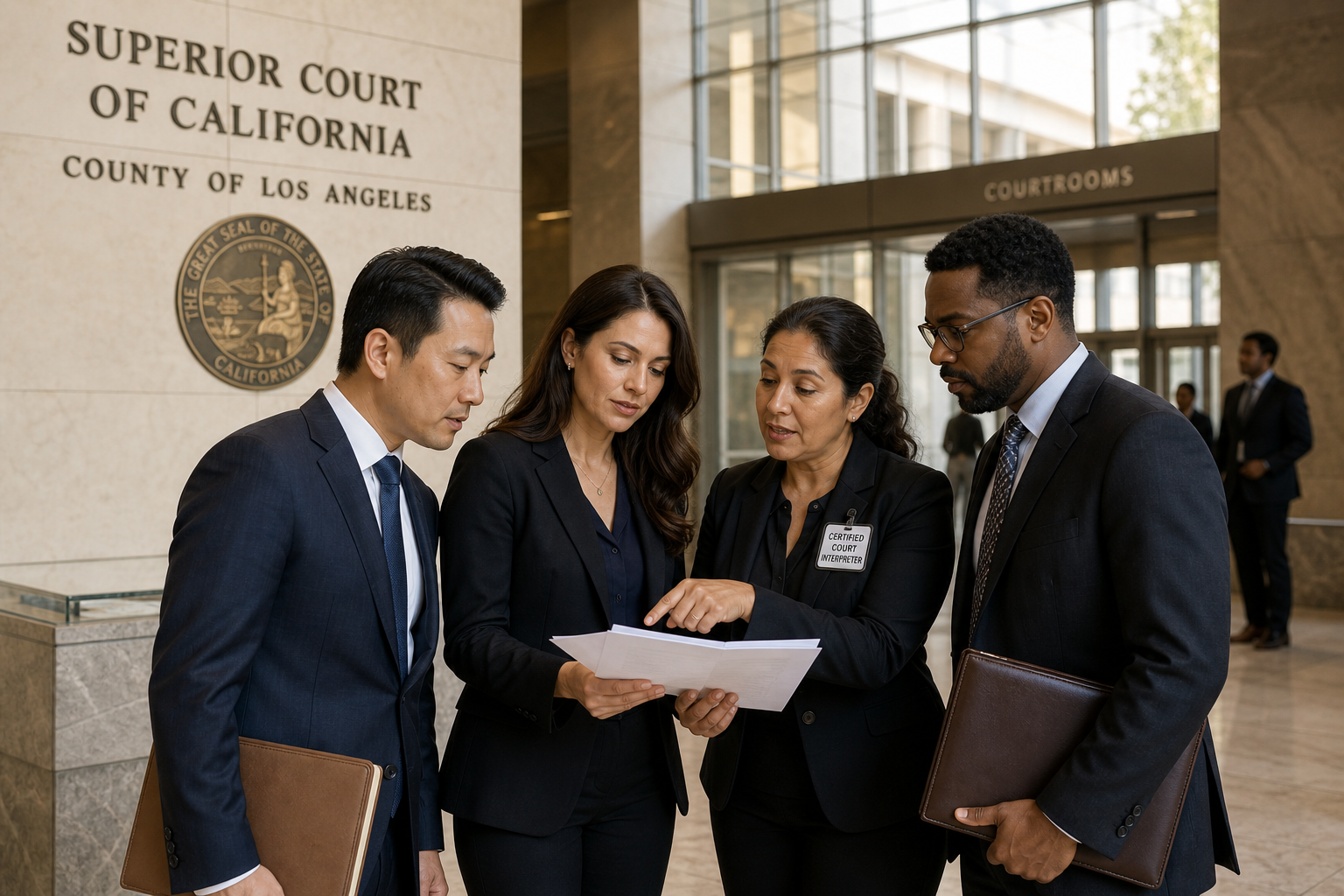
- California law requires certified or registered interpreters for court proceedings — bilingual staff or informal interpreters don't qualify.
- Verify credentials through the Judicial Council of California's official registry before booking.
- For depositions, IME/QME appointments, and hearings, demand written confirmation of certification, language pair, and availability window.
- Working with an established agency eliminates last-minute cancellations and compliance gaps.
If you've ever scrambled to find a court interpreter at the last minute — or worse, had a proceeding delayed because the interpreter didn't meet California's credentialing requirements — you know how costly the wrong approach can be. Attorneys lose billable time. Claims managers delay settlements. And clients are left in limbo.
California has some of the most rigorous court interpreter standards in the country, and for good reason: the state's courts handle millions of cases annually involving speakers of over 200 languages. Getting the credentials right isn't bureaucratic box-checking — it's the foundation of a fair proceeding and an admissible record.
This guide walks you through every step of hiring a certified court interpreter in California, from understanding the credential tiers to what questions to ask an agency before you confirm a booking.
Why California Court Interpreter Credentials Matter
California Government Code §68560 et seq. and the Judicial Council Rules require that interpreters in criminal proceedings be certified. For civil matters, depositions, and administrative hearings, the standards vary — but the practical and professional expectation is the same: a credentialed, impartial, professionally trained linguist.
There are three credential tiers to understand:
1. Certified Court Interpreter (CCI)
The gold standard. Issued by the Judicial Council of California after passing a rigorous written and oral examination. Available only for the highest-demand languages (Spanish, Mandarin, Cantonese, Vietnamese, Korean, Japanese, Portuguese, Tagalog, and others). These interpreters have demonstrated professional-grade consecutive, simultaneous, and sight-translation skills.
2. Registered Interpreter
For languages where the Judicial Council has not yet developed a certification exam, interpreters can apply for registered status after completing an orientation and background check. Registered interpreters are authorized for use in court proceedings in their language pair.
3. Provisionally Qualified Interpreter
Used as a last resort when no certified or registered interpreter is available. Courts must make findings on the record. This is not an acceptable standard for depositions or pre-planned legal proceedings — if you're booking in advance, there is no reason to accept a provisionally qualified interpreter.
For workers' compensation proceedings, the Division of Workers' Compensation (DWC) has its own requirements under California Code of Regulations Title 8, §9795.3. Interpreters for medical-legal evaluations (IME/QME) must meet both language skill and professional conduct standards. Learn more about the full workers' compensation interpreting landscape in California.
Step 1: Define What Type of Proceeding You're Booking For
The first question isn't "who's available?" — it's "what am I booking for?" The format of the proceeding determines the skill set required:
- Courtroom hearing or trial: Requires simultaneous and consecutive interpretation; certified interpreter preferred; check local court's administrative rules on approved interpreters.
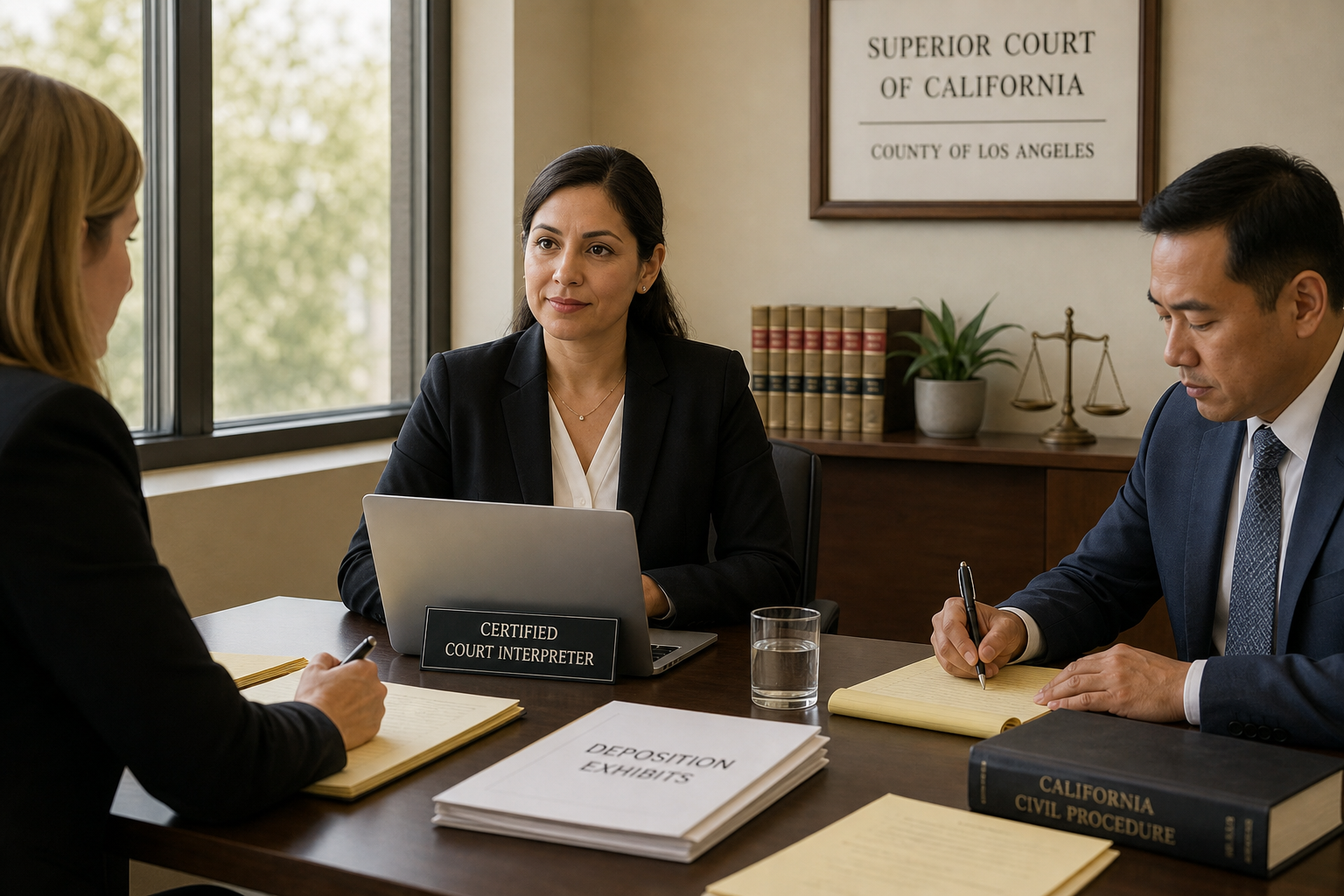
- Deposition: Consecutive interpretation (Q&A format); certified legal interpreter strongly preferred; the transcript will be used in court, so accuracy is critical.
- IME / QME medical-legal evaluation: Consecutive interpretation in a clinical setting; interpreter must remain impartial and not advocate; must comply with DWC Title 8 §9795.3.
- Arbitration or administrative hearing: Similar requirements to depositions; check the specific administrative body's interpreter policy.
- Client interview or legal consultation: Certified preferred but not legally mandated; consecutive interpretation; confidentiality is paramount.
Documenting the proceeding type before you start searching ensures you brief the agency correctly and receive an interpreter with the right skill profile. Our on-site interpreting team handles all of these formats across California — with advance briefing materials provided to the interpreter when available.
Step 2: Verify Interpreter Credentials Before You Confirm
Never rely solely on an interpreter's resume or an agency's verbal assurance. California's Judicial Council maintains the California Court Interpreter Registry, a publicly searchable database of all certified and registered interpreters in the state. You can search by name, language, and county.
What to verify:
- Active status: Certification must be current — not lapsed or suspended.
- Language pair: Confirm the source and target language exactly. "Spanish" is not the same as "Spanish (Latin American — agricultural dialect)."
- Specialization: Legal interpreting is a specialized discipline. Ask whether the interpreter has experience in your specific proceeding type (deposition, trial, WC hearing).
- Background check: For any proceedings involving sensitive records, confirm the interpreter has a current background clearance.
If you're working through an agency, ask them to provide the credential verification in writing before the booking is confirmed. A reputable agency should have this on file and be able to share it instantly.
Step 3: Choose On-Site or Remote Interpreting
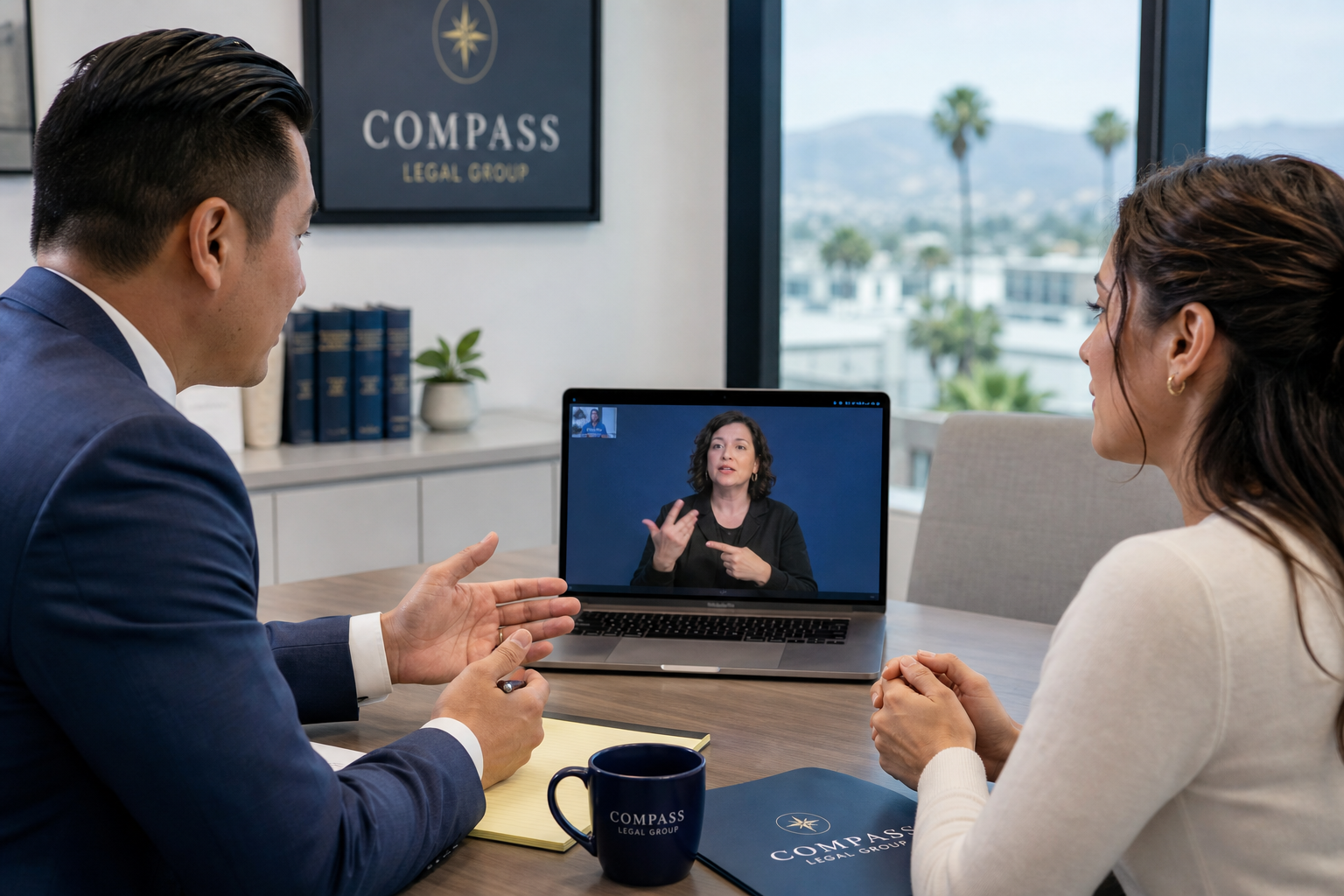
California proceedings increasingly use Video Remote Interpreting (VRI), particularly for depositions in insurance and workers' comp matters. Both formats are valid — the right choice depends on the proceeding.
| Format | Best For | Watch Out For |
|---|---|---|
| On-Site | Complex depositions, high-stakes trials, IME/QME with emotional or physical examination components | Scheduling lead time; interpreter availability in rural CA counties |
| VRI | Routine depositions, follow-up hearings, client interviews, multi-party proceedings | Platform reliability; must be HIPAA-compliant for medical matters |
Ortiz Schneider provides both formats statewide. Our remote interpreting services use secure, encrypted platforms that meet HIPAA standards for medical-legal proceedings. For complex depositions in San Francisco, Los Angeles, Fresno, or across the Central Valley, on-site assignment is typically the right call.
Step 4: Brief the Interpreter Before the Proceeding
One of the most overlooked steps in legal interpreting — and one of the biggest sources of avoidable errors — is failing to brief the interpreter before the proceeding. Even the most experienced certified court interpreter benefits from context:
- Case overview: Nature of the case (personal injury, WC claim, criminal defense, contract dispute), parties involved, general subject matter.
- Terminology list: Industry-specific terms, medical diagnoses, trade names, or proper nouns. A QME involving orthopedic injuries will use different vocabulary than a deposition about farm labor contract terms.
- Proceeding format: Will the interpreter be switching between consecutive and simultaneous? Will there be multiple languages? Will exhibits be handed to the witness?
- Estimated duration: Interpreting is cognitively demanding. Proceedings over 3–4 hours may require a team of two interpreters for quality maintenance.
A professional agency will collect this information at intake and pass it to the assigned interpreter with sufficient lead time. If an agency doesn't ask these questions, that's a red flag.
Step 5: Confirm the Logistics in Writing
Verbal bookings create liability. Before any proceeding, confirm the following in writing (email or agency portal confirmation is fine):
- Interpreter name and credential number
- Language pair (source → target)
- Date, time, and location (or platform link for VRI)
- Expected duration and any overtime rates
- Cancellation / reschedule policy
- Impartiality and confidentiality attestation
Agencies like Ortiz Schneider provide written booking confirmations with all interpreter credential details included as standard practice. This protects all parties — attorney, claims manager, insurer, and client.
Questions to Ask Any Interpreting Agency Before You Book
Not all interpreting agencies are created equal. California has no shortage of language services vendors, but for legal and WC proceedings, the credentialing and quality standards vary significantly. Here's what to ask:
- "Is the interpreter certified by the Judicial Council of California?" If the language has a certification exam, the answer should be yes. Don't accept "highly qualified" as a substitute for "certified."
- "Can you provide the interpreter's certification number for verification?" Any legitimate agency can do this in minutes.
- "What is your cancellation policy if the assigned interpreter becomes unavailable?" Same-day substitutions happen — know in advance whether the agency will cover with an equally credentialed backup.
- "Do your interpreters sign a confidentiality agreement?" Required for any proceeding involving privileged communications or HIPAA-protected health information.
- "Do you have experience with [specific proceeding type]?" Depositions, QME/IME evaluations, and DWC hearings each have distinct protocols — the agency should be able to name their experience.
- "What is your service area?" For Central Valley WC cases involving agricultural workers, coverage in Fresno, Salinas, Bakersfield, and surrounding counties matters as much as LA and SF availability.
Ortiz Schneider has served California's legal, insurance, and workers' comp communities since 1999. We can answer all of these questions — in writing, before you book. Request a quote and our team will match you with a certified interpreter for your proceeding within the hour.
Common Mistakes When Hiring a Court Interpreter in California
Even experienced legal and claims professionals make these errors — often because the stakes of an interpreting decision aren't visible until something goes wrong:
- Using a bilingual employee or family member. This is legally prohibited in California court proceedings and creates serious impartiality and confidentiality risks. It happens most often in workers' comp evaluations and clinical settings.
- Booking a "translator" for an interpreting assignment. Translation is written. Interpreting is spoken. The skills are distinct, and a translator is not an interpreter. The error seems minor until the deposition record is challenged.
- Not specifying the dialect. A Spanish-speaking farm worker from Oaxaca may speak Mixtec as a first language and have limited academic Spanish. A certified Spanish interpreter fluent in formal legal Spanish may not be the right match for this proceeding. Brief the agency on the specific population.
- Booking too late for rural or specialty languages. Certified interpreters for languages like Punjabi, Hmong, Mixtec, or Tigrinya in rural California counties may require 5–10 business days of lead time. Plan ahead.
- Failing to confirm credentials before the proceeding. A 30-second registry check before a 6-hour deposition can prevent a day of wasted court time.
FAQs: Hiring a Court Interpreter in California
Is a certified interpreter legally required for all California court proceedings?
For criminal proceedings, yes — California Government Code §68560 requires certified interpreters. For civil matters and depositions, it is not always legally mandated but is strongly recommended and is the professional standard. For DWC workers' comp hearings and medical-legal evaluations, specific interpreter qualifications are required under Title 8 of the California Code of Regulations.
How far in advance do I need to book?
For Spanish and major languages in major urban areas (Los Angeles, San Francisco, San Jose, Sacramento), 24–48 hours is often sufficient. For specialty languages, rural counties, or extended multi-day depositions, 5–10 business days is recommended. Always book with buffer time — late cancellations happen, and you want the agency to have time to source a credentialed backup.
What's the difference between consecutive and simultaneous interpreting?
Consecutive interpretation means the speaker pauses while the interpreter renders each segment — standard for depositions, client interviews, and most legal proceedings. Simultaneous interpretation means the interpreter speaks at the same time as the source speaker (usually via headset equipment) — used in large courtroom settings, multi-party trials, and high-volume proceedings. Both require different skill sets; make sure your booking specifies which is needed.
Can I use VRI for depositions in California?
Yes. California courts and the workers' comp system have accepted VRI for depositions and administrative proceedings. The interpreter must still meet all credentialing requirements regardless of format. For medical-legal QME/IME appointments, VRI is widely used. Confirm the platform is HIPAA-compliant if the proceeding involves protected health information.
What languages are most commonly needed in California courts?
Spanish is by far the most requested, accounting for roughly 80% of court interpreting assignments in California. Mandarin, Cantonese, Vietnamese, Korean, Tagalog, Punjabi, Arabic, and Hmong follow. In the Central Valley agricultural regions, indigenous Mexican languages (Mixtec, Zapotec, Triqui) are increasingly common in workers' comp and farm labor proceedings.
Does Ortiz Schneider cover all of California?
Yes. We provide certified court and legal interpreters statewide — Los Angeles, San Francisco, San Jose, Sacramento, Fresno, Salinas, Santa Barbara, San Diego, Oxnard, and rural counties throughout the Central Valley and beyond. See why California's legal and insurance professionals trust Ortiz Schneider for high-stakes proceedings.
Ready to Book a Certified Court Interpreter?
Ortiz Schneider has been California's trusted language access partner for legal, workers' comp, and insurance proceedings since 1999. Our certified linguists bring professional training, current credentials, and the discretion that high-stakes legal proceedings demand.
Whether you need an on-site interpreter for a Los Angeles deposition, a VRI-enabled IME appointment in Fresno, or a same-week booking for an administrative hearing in San Francisco — our team is ready.
Request a quote or contact our team to confirm availability. We respond within the hour on business days.