What Is IME/QME Interpreting in California Workers' Comp? A Complete Guide
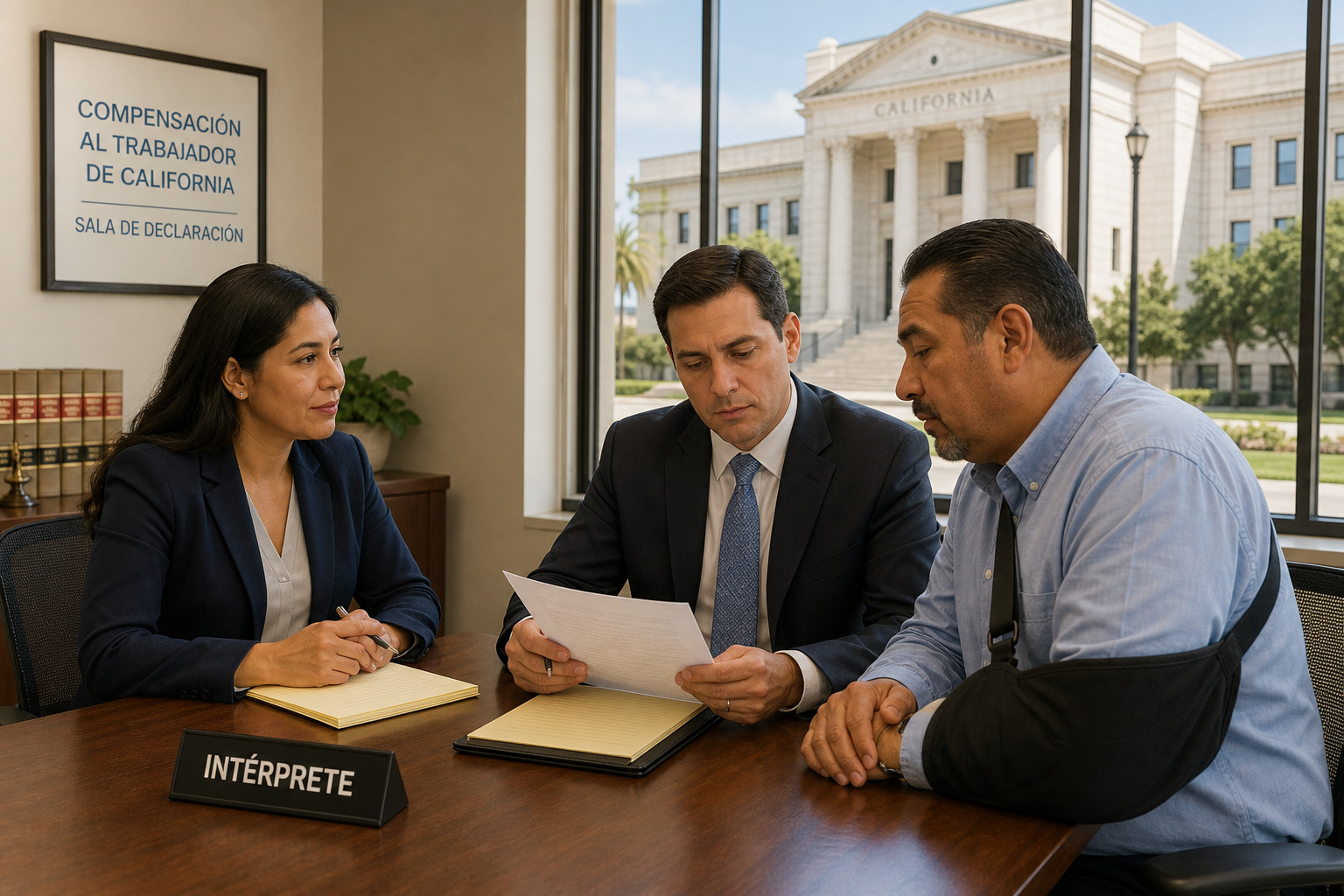
📌 Quick Summary
- IME (Independent Medical Examination) and QME (Qualified Medical Evaluator) appointments are critical milestones in California workers' comp claims — they often determine the extent of permanent disability and final settlement value.
- California law (Labor Code § 4600) and DWC regulations require that injured workers receive interpreter services at medical-legal evaluations at no cost to the worker.
- — not bilingual office staff — should interpret at IME/QME appointments to ensure accuracy and impartiality.
- Common languages needed statewide include Spanish, Vietnamese, Tagalog, Punjabi, Mixtec, and Cantonese, reflecting California's diverse workforce.
- Ortiz Schneider provides certified on-site and VRI interpreters for IME/QME evaluations throughout California, from Los Angeles to Fresno to Salinas.
When an injured worker in California files a workers' compensation claim, one of the most consequential steps in the process is the medical-legal evaluation — either an Independent Medical Examination (IME) or a Qualified Medical Evaluator (QME) appointment. These evaluations can determine the degree of permanent disability, whether additional medical treatment is authorized, and ultimately the value of a settlement.
For the millions of California workers whose primary language is not English, these appointments present a serious challenge. Without a qualified interpreter, a Spanish-speaking farmworker in Fresno, a Vietnamese garment worker in Los Angeles, or a Punjabi agricultural laborer in the Central Valley may not be able to accurately describe their symptoms, understand the physician's questions, or meaningfully participate in an evaluation that will shape their financial future.
This guide explains exactly what IME/QME interpreting involves, what California law requires, and how claims administrators and injured workers can ensure language access is handled correctly.
What Is an IME and What Is a QME?
In California's workers' compensation system, two types of physician evaluations are commonly used to resolve disputes about medical conditions and disability:
Independent Medical Examination (IME)
An IME is requested by the insurance carrier or employer to obtain a second medical opinion regarding an injured worker's condition, treatment needs, or level of disability. The IME physician is selected by the defense — the insurer or employer — and provides an independent assessment that can support or challenge the treating physician's findings.
Qualified Medical Evaluator (QME)
A QME is a physician certified by California's Division of Workers' Compensation (DWC) Medical Unit. QME appointments are used to resolve disputes between the injured worker and the claims administrator over medical issues, including the extent of permanent disability, causation, and future medical care needs. In unrepresented cases, the injured worker selects a QME from a panel provided by the DWC. In represented cases, an Agreed Medical Evaluator (AME) may be used instead.
Both types of evaluations carry substantial weight in the claims process. A QME's Comprehensive Medical-Legal Report (CMLR) often becomes the definitive document used by the Workers' Compensation Appeals Board (WCAB) to assess permanent disability and authorize treatment.
Why Language Access at IME/QME Appointments Matters So Much
The stakes at IME and QME evaluations are extremely high. During these examinations, the physician needs to:
- Take a detailed history of the injury and how it occurred
- Understand the worker's subjective complaints — pain levels, functional limitations, sleep disruption, psychological impact
- Assess the worker's prior medical history and pre-existing conditions
- Evaluate the worker's current functional capacity and restrictions
Every one of these steps depends on accurate, two-way communication. A worker who cannot clearly describe where their pain radiates, how their injury affects their ability to lift or stand, or what activities they can no longer perform may receive an evaluation report that significantly underestimates their disability — not because the physician was negligent, but because the communication simply broke down.
According to a 2021 analysis by the California Workers' Compensation Institute (CWCI), language barriers in medical evaluations are among the most frequently cited contributing factors in disputed workers' comp claims involving non-English-speaking workers. The downstream effects — re-evaluations, appeals to the WCAB, delayed settlements — are costly for all parties.
This is why certified IME/QME interpreters are not a luxury. They are a legal requirement and a practical necessity for claim integrity.
What California Law Says About Interpreter Access
California Labor Code § 4600 requires that employers and claims administrators provide interpreter services for injured workers who need them to communicate with physicians in workers' compensation medical appointments. This right applies to:
- Treating physician appointments
- IME examinations
- QME and AME evaluations
- Medical-legal appointments of all kinds
The cost of the interpreter is borne by the employer or claims administrator — not the injured worker. This is a critical protection, particularly for low-wage workers in agriculture, construction, food processing, and other industries with high concentrations of non-English-speaking employees.
The DWC's regulations also specify that interpreters at workers' comp medical-legal evaluations must meet minimum qualification standards. Unqualified bilingual staff or family members are not permitted to serve as interpreters at these appointments — doing so creates serious liability exposure for the claims administrator and compromises the integrity of the evaluation.
are specifically designed to meet California DWC requirements for medical-legal evaluations — certified linguists, documented qualifications, and a process built for the demands of the claims environment.
What Qualifies as a "Certified" IME/QME Interpreter in California?
California has specific credentialing pathways for interpreters working in workers' compensation settings. The DWC recognizes the following categories of qualified medical interpreters:
Certified Healthcare Interpreters (CHIs)
Credentialed by the Certification Commission for Healthcare Interpreters (CCHI) or the National Board of Certification for Medical Interpreters (NBCMI), CHIs have passed rigorous written and oral examinations covering medical terminology, ethical standards, and interpreting protocols.
Court-Certified Interpreters
California State Court-Certified Interpreters — those certified by the Judicial Council of California — are recognized as qualified interpreters in workers' comp medical-legal settings for the languages in which they hold certification.
Provisionally Qualified Interpreters
For languages where certified interpreters are limited or unavailable, California regulations provide for the use of provisionally qualified interpreters who meet alternative documented criteria, including demonstrated language proficiency and interpreting experience.
At Ortiz Schneider, our linguists working in workers' comp medical-legal settings hold recognized credentials and have specific experience with the medical and legal vocabulary used in IME/QME examinations. Our interpreters understand the difference between an "apportionment" and an "aggravation," can accurately interpret a physician's description of range of motion limitations, and know how to maintain strict impartiality throughout the evaluation.
On-Site vs. VRI for IME/QME Interpreting: Which Is Better?
One of the most common questions we hear from claims administrators and case managers is whether video remote interpreting (VRI) is appropriate for IME/QME appointments, or whether on-site interpreting is required.
The answer depends on several factors:
When On-Site Interpreting Is Preferred
- — A comprehensive medical-legal evaluation covering multiple body parts or a psychiatric component may last two or three hours. On-site interpreting eliminates technology fatigue and ensures the interpreter can pick up on non-verbal cues.
- — Many injured workers in agricultural and construction industries are unfamiliar with video platforms. Technical difficulties during a QME appointment can derail the evaluation and require rescheduling.
- — For workers who speak regional dialects (Mixtec, Triqui, or other indigenous languages common in California's Central Valley and Salinas Valley farmworker communities), on-site interpreting by a linguist with documented dialect competency is strongly preferred.
- — When the evaluation requires the physician to give the worker physical instructions (range of motion testing, strength testing, neurological examination), having an interpreter physically present reduces errors.
When VRI Is Appropriate
- — When the evaluation is primarily records-based with limited worker interaction, VRI can be a practical and cost-effective option.
- — In areas where on-site certified interpreters in a specific language are not available within a reasonable travel radius, HIPAA-compliant VRI through a qualified agency is a legitimate and legally defensible alternative.
- — When a QME appointment must be scheduled quickly to meet statutory deadlines (the QME appointment must occur within 60 days of the panel selection in most cases), VRI can be deployed more rapidly than arranging on-site coverage.
teams both serve the California workers' comp market. Our case managers can help you determine the right modality for each evaluation based on the language pair, evaluation type, and location.
Languages Most Commonly Needed for IME/QME Interpreting in California
California has one of the most linguistically diverse workforces in the world. Based on DWC data and our own service history, the languages most commonly needed for workers' comp medical-legal evaluations in California include:
- — By far the most requested language, particularly in Los Angeles, San Bernardino, Riverside, Fresno, Tulare, Monterey, and Santa Barbara counties, where large populations of agricultural workers, construction workers, and service industry employees are concentrated.
- — Significant need in Orange County, Santa Clara County, and the greater Los Angeles area, with Vietnamese-speaking workers concentrated in electronics manufacturing, nail and beauty industries, and food processing.
- — Consistently high demand in Los Angeles, San Diego, and the San Francisco Bay Area, particularly in healthcare, domestic work, and hospitality industries.
- — Growing need in the Central Valley, particularly in Fresno, Tulare, and Kings counties, where Sikh Punjabi farming families represent a substantial portion of the agricultural workforce.
- — A critically underserved need in the Salinas Valley, Oxnard, and other coastal agricultural areas. Mixtec-speaking workers from Oaxaca, Mexico represent a significant portion of California's farm labor force, and Mixtec is a distinct indigenous language — not a Spanish dialect. Specialized interpreters are required.
- — Needed in the San Francisco Bay Area and Los Angeles, particularly in restaurant, retail, and manufacturing industries.
- — Consistent demand in Los Angeles County, particularly in the garment, restaurant, and retail sectors.
- — Needed in the Glendale, Burbank, and greater San Fernando Valley areas of Los Angeles County.
Ortiz Schneider maintains a network of certified linguists in 200+ languages across California. We have particular depth in Spanish, Vietnamese, Tagalog, and the indigenous languages of the Central Valley — including Mixtec variants — precisely because these are the communities where workers' comp language access gaps are most acute.
The IME/QME Interpreting Process: What to Expect
Here's how a well-managed IME/QME interpreting engagement typically works when coordinated through a professional agency:
- — The claims administrator, defense attorney, or QME physician's office contacts Ortiz Schneider with the appointment details: date, time, location (or VRI platform), language needed, and evaluation type.
- — We match the assignment to a certified linguist with relevant workers' comp and medical-legal experience in the required language. For specialized dialects or uncommon languages, we confirm interpreter credentials with the requesting party in advance.
- — Our team confirms the assignment with the interpreter and provides any available background on the case type (orthopedic, psychiatric, internal medicine, etc.) so the interpreter can prepare relevant terminology.
- — The interpreter arrives on-site (or connects via our VRI platform) and facilitates communication between the physician and the injured worker throughout the evaluation. The interpreter adheres strictly to the professional ethics of impartiality, accuracy, and confidentiality.
- — Ortiz Schneider provides proof-of-service documentation confirming interpreter attendance, credentials, and hours for the claims file.
Common Mistakes Claims Administrators Make with IME/QME Interpreting
After more than 25 years serving California's workers' comp community, our team at Ortiz Schneider has observed several recurring mistakes that compromise evaluation quality and expose claims administrators to liability:
Using Bilingual Office Staff
Physician's office staff, even those who speak the worker's language fluently, are not professional interpreters. They have not been trained in consecutive or simultaneous interpreting techniques, medical-legal terminology, or the ethical standards required of professional interpreters. Using office staff as interpreters is specifically discouraged under California DWC guidelines and creates ambiguity about interpreter qualifications in the claims file.
Assuming Spanish = Spanish
Spain Spanish, Mexican Spanish, and the regional variants spoken in Los Angeles, Fresno, and Salinas are mutually intelligible for most purposes — but assuming that any Spanish-speaking interpreter can effectively serve a Mixtec-speaking worker is a serious error. Mixtec is not Spanish. It is an indigenous Oto-Manguean language with several distinct variants. Sending a Spanish interpreter to a Mixtec-speaking worker's QME appointment produces a non-evaluation, not an evaluation.
Leaving Language Access Arrangements to the Last Minute
QME appointments are time-sensitive by statute. If interpreter arrangements fall through on the day of the appointment, the evaluation may need to be rescheduled — potentially restarting the 60-day clock and delaying claim resolution. Confirm interpreter arrangements at least 72 hours in advance.
Not Documenting Interpreter Credentials
The interpreter's qualifications should be documented in the claims file. In the event of a dispute at the WCAB, the adequacy of language access at the QME evaluation may be challenged. Documentation of interpreter credentials — certification number, agency affiliation, years of experience — is your protection.
Serving California's Workers' Comp Community from Santa Barbara to Salinas
Ortiz Schneider was founded in 1999 in Santa Barbara, California, and we have spent more than 25 years building a certified interpreter network specifically calibrated for California's workers' comp industry. We serve claims administrators, defense attorneys, QME physicians, applicant attorneys, and injured workers throughout the state.
Our coverage includes:
- — Los Angeles County, Orange County, Ventura County, San Bernardino County, Riverside County
- — Fresno, Tulare, Kings, Kern, Madera, Merced, Stanislaus, San Joaquin counties
- — Santa Barbara, San Luis Obispo, Monterey (including Salinas), Santa Cruz
- — San Francisco, San Jose, Oakland, Santa Clara County
- — Sacramento, Placer, El Dorado, Yolo counties
- — San Diego County and surrounding areas
For evaluations in rural agricultural areas — including the Salinas Valley, Oxnard Plain, and the eastern San Joaquin Valley — we have particular experience coordinating on-site coverage in locations that are off the beaten path for most interpreting agencies.
Frequently Asked Questions About IME/QME Interpreting in California
Is the insurance company required to pay for the interpreter at a QME appointment?
Yes. Under California Labor Code § 4600, interpreter services at medical appointments — including QME evaluations — are the responsibility of the employer/insurer. The injured worker cannot be charged for interpreter services.
Can a family member interpret at a QME?
No. California DWC regulations require qualified interpreters at medical-legal evaluations. Family members are not permitted to serve as interpreters at IME or QME appointments, both because of accuracy concerns and because family members have a personal interest in the outcome of the claim.
What happens if the evaluation proceeds without an interpreter and the worker needed one?
The injured worker or their attorney may challenge the adequacy of the evaluation at the WCAB, potentially requiring a new evaluation at the claims administrator's expense. This is a significant and entirely avoidable cost.
How much notice does Ortiz Schneider need to arrange an interpreter for a QME?
For most language combinations, we can confirm interpreter coverage with 24–48 hours' notice. For less common languages or regional dialects (such as Mixtec variants), we recommend providing 5–7 business days for optimal coverage. Rush arrangements are available when appointment timelines are urgent.
Does Ortiz Schneider provide interpreters for psychiatric QME evaluations?
Yes. Psychiatric and psychological QME evaluations require interpreters with specific competencies in mental health terminology and sensitivity to the nature of psychiatric examination. We match psychiatric evaluation assignments to linguists with documented experience in behavioral health settings.
Can Ortiz Schneider provide certified interpreters for depositions that follow a QME dispute?
cover depositions, hearings before the WCAB, and all phases of workers' compensation litigation. When a claim moves from the medical evaluation stage to formal dispute resolution, we can provide certified interpreters with continuity throughout the process.
Ready to Schedule an IME/QME Interpreter in California?
Accurate, certified interpreting at IME and QME evaluations is one of the most important — and most overlooked — factors in California workers' comp claim integrity. When language access is handled correctly, evaluations produce reliable, defensible reports. When it isn't, the consequences range from disputed evaluation reports to costly WCAB proceedings.
Ortiz Schneider has provided certified language access services to California's workers' compensation community since 1999. Our interpreters are credentialed, experienced in medical-legal settings, and available throughout the state — on-site and via HIPAA-compliant VRI.