Cultivating Communication: The Essential Role of Interpreting in California Agribusiness
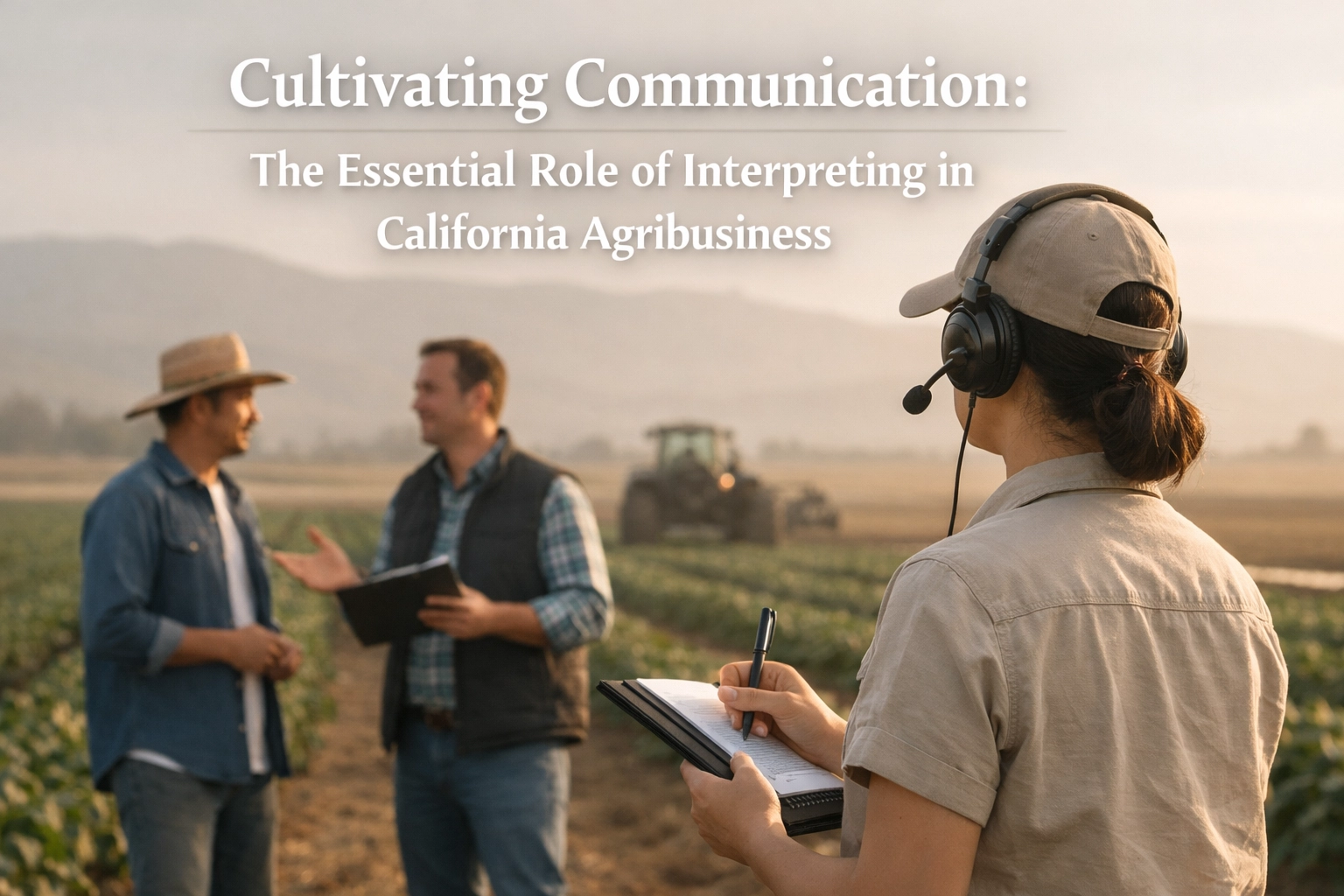
California's agricultural sector generates over $50 billion annually, making it the nation's leading agricultural producer. Yet behind those impressive numbers lies a complex operational reality: thousands of multilingual workers collaborating across farms, processing facilities, and corporate offices throughout the state. For agribusinesses operating in regions like Salinas and San Jose, effective communication isn't just convenient: it's critical to safety, productivity, and compliance.
The Central Valley, Salinas Valley, and surrounding agricultural regions represent some of the most linguistically diverse workplaces in America. Spanish is predominant, but Indigenous languages from Mexico and Central America, including Mixteco, Zapoteco, and Triqui, are increasingly common. When a supervisor needs to explain proper pesticide application procedures or an HR manager must conduct a workplace investigation, accurate interpreting becomes the foundation of operational success.
The High Stakes of Agricultural Safety Training
Agricultural work involves inherent risks. Heavy machinery, chemical applications, confined spaces, and weather exposure create environments where miscommunication can have serious, even fatal, consequences. When safety protocols aren't clearly understood, accident rates increase, workers face preventable injuries, and companies encounter liability issues.
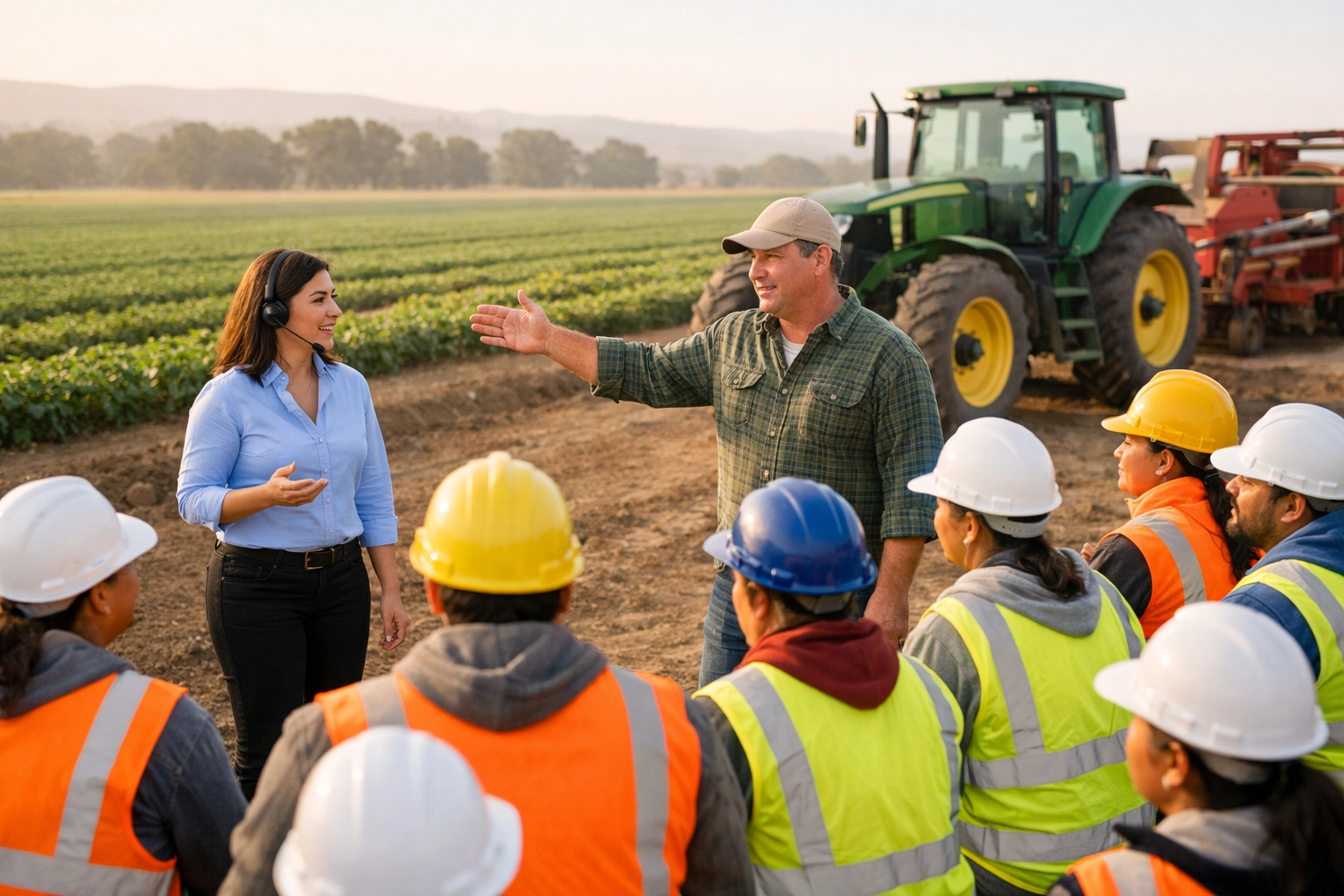
Professional agricultural interpreting services in California ensure that safety briefings reach every worker in their primary language. This goes beyond simple word-for-word translation. Interpreters with agricultural expertise understand industry-specific terminology, from the technical specifications of irrigation systems to the proper handling procedures for restricted-use pesticides. They know that "personal protective equipment" isn't just PPE: it's the difference between a safe shift and a hospital visit.
Consider a scenario common across California farms: a new harvesting crew receives training in equipment operation. The machinery is sophisticated, the stakes are high, and the workforce speaks three different languages. On-site interpreting California services allow trainers to deliver consistent, accurate safety information simultaneously to all workers, regardless of their linguistic background. Questions get answered immediately, confusion gets clarified on the spot, and everyone leaves with the same critical knowledge.
HR Operations and Labor Compliance
California's agricultural labor laws are among the most comprehensive in the nation. From overtime regulations to heat illness prevention requirements, agribusinesses must navigate complex compliance obligations while maintaining clear communication with diverse workforces.
Human resources departments regularly handle sensitive situations requiring professional interpreting support. During employee onboarding, new hires need to understand their rights, benefits, workplace policies, and safety protocols; clear communication from day one sets the tone for the entire employment relationship. Performance reviews also require language access so employees fully comprehend feedback, improvement plans, and advancement opportunities—reducing misunderstandings that can harm morale and create avoidable risk.
Workplace investigations are another common pressure point. When complaints arise—whether about safety, harassment, or policy violations—accurate documentation is essential, and professional interpreters help ensure witness statements, interviews, and findings are precisely recorded and understood by all parties. Likewise, disciplinary procedures require due process: employees must clearly understand allegations and have the opportunity to respond, and agricultural interpreting California support protects both employer and employee interests through transparent, documented communication.

For agricultural HR teams managing seasonal workforce fluctuations, having reliable interpreting access isn't optional: it's fundamental to legal compliance and ethical employment practices.
Field Operations and Cultural Precision
Beyond safety and HR, day-to-day agricultural operations require constant communication across language barriers. Crop management, quality control, harvest scheduling, and equipment maintenance all involve detailed instructions that must be accurately conveyed and fully understood.
This is where cultural precision becomes as important as linguistic accuracy. Professional interpreters with agricultural experience understand the cultural contexts that shape communication in farm settings. They recognize regional variations in agricultural terminology, respect traditional farming knowledge, and navigate the hierarchical structures common in agricultural workplaces.
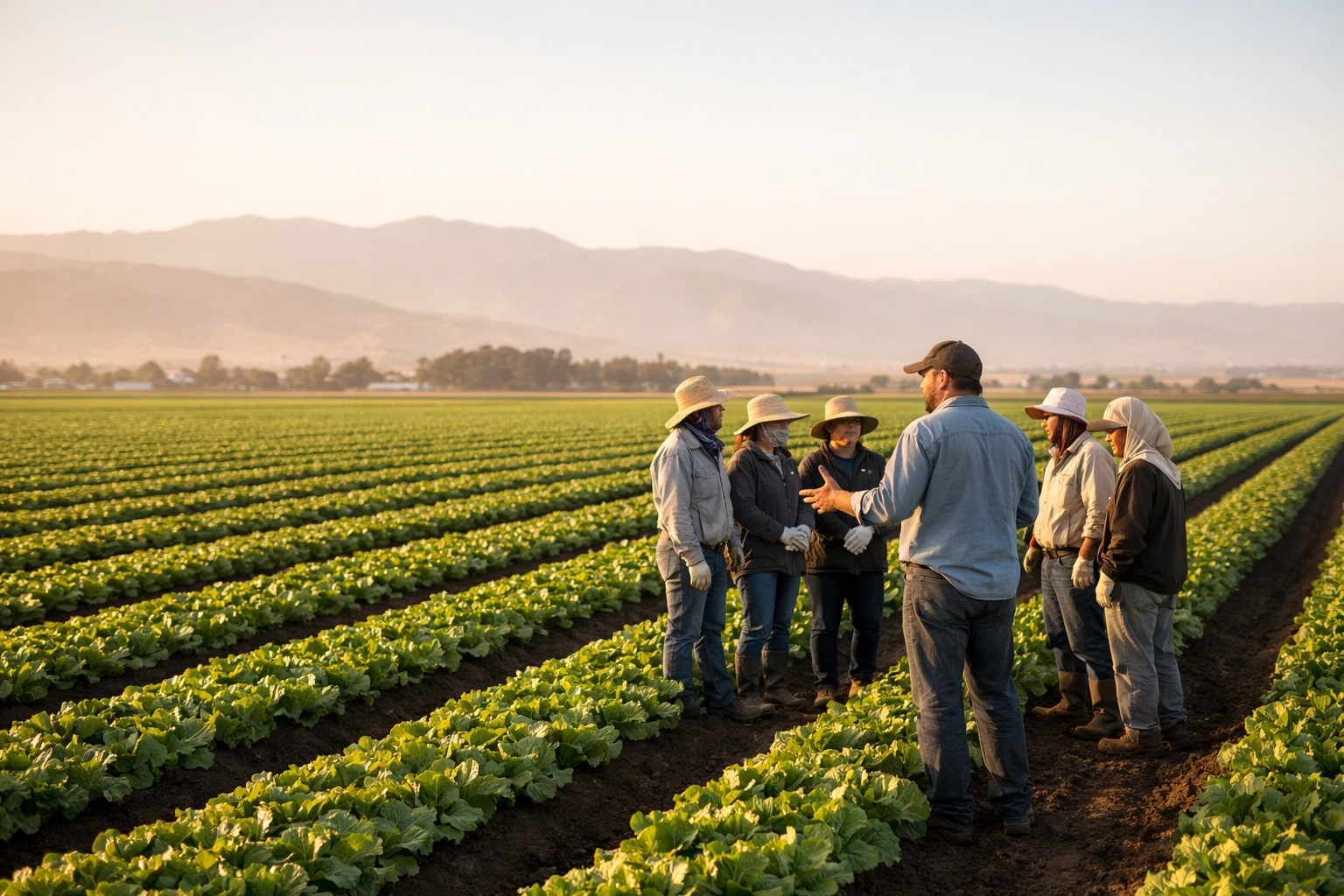
In Salinas, known as the "Salad Bowl of the World," lettuce producers coordinate complex harvest operations involving hundreds of workers. Timing is everything: crops must be harvested at peak freshness, sorted by quality standards, and shipped within tight windows. When field supervisors communicate with harvest crews, every instruction matters. Professional agricultural interpreting ensures that quality specifications, harvest techniques, and productivity expectations are clearly understood by workers whose expertise drives California's agricultural success.
San Jose's surrounding agricultural regions face similar communication challenges, particularly in specialty crop production and organic farming operations where specific handling requirements and certification standards add layers of complexity. Remote interpreting services in California options provide flexibility for operations spanning multiple sites, allowing managers to access professional interpreters via phone or video when on-site presence isn't immediately available.
Choosing the Right Interpreting Model for Agricultural Settings
Agricultural operations benefit from multiple interpreting delivery models, each suited to specific scenarios. For hands-on trainings and high-context conversations, on-site interpreting California support is often the best fit—especially for safety training sessions, equipment demonstrations, and workplace investigations where the interpreter can observe body language, reference physical equipment, and facilitate group discussions effectively.
When you need visual connection without waiting for travel, VRI interpreting in California (video remote interpreting) is a strong option for HR meetings, manager consultations, and multi-site coordination. It also helps agribusinesses access qualified interpreters quickly, including for less common Indigenous languages. For rapid, day-to-day questions where visuals aren’t essential, remote interpreting services in California, like over-the-phone interpreting (OPI) provide immediate access for quick clarifications and routine communication.
Agricultural businesses increasingly adopt hybrid approaches, using on-site interpreting for scheduled training and complex situations while maintaining remote interpreting services for ad hoc needs and multi-site coordination.
The Cost of Inadequate Language Access
When agribusinesses attempt to manage language barriers without professional interpreting support, the consequences extend far beyond communication frustration. Misunderstood safety instruction scan lead to preventable accidents, worker injuries, and workers’ compensation claims—making workers’ compensation interpreters a practical safeguard when incidents occur and statements, treatment plans, or return-to-work instructions must be understood clearly.
The compliance impact is real, too. Cal/OSHA and other regulators expect safety training and workplace information to be delivered in languages workers understand, and failures can trigger citations and increased scrutiny. Over time, communication barriers can also damage labor relations by breeding mistrust, lowering morale, and increasing turnover in an industry already facing workforce challenges.
Finally, language gaps create legal and operational exposure. Employment disputes and contract disagreements often trace back to communication breakdowns that professional interpreting could have prevented, while day-to-day inefficiency shows up as repeated instructions, errors, and rework. Clear communication the first time improves productivity across agricultural operations.
Why Specialized Agricultural Interpreting Matters
Not all interpreting services understand agriculture. The sector has unique vocabulary, cultural dynamics, and operational contexts that require specific expertise. A medical interpreter, however skilled, likely won't know the technical terminology for drip irrigation systems. A legal interpreter may not understand the cultural protocols important in agricultural workplaces.
Family-run language services agencies with decades of California agricultural experience bring invaluable industry knowledge to every assignment. Since 1999, Ortiz Schneider has built deep expertise in agricultural interpreting, understanding both the linguistic requirements and the operational realities of California farming. Our interpreters know the difference between furrow and flood irrigation, understand harvest season pressures, and respect the agricultural traditions that shape workplace interactions.
This specialization ensures accuracy, efficiency, and cultural appropriateness—qualities that generic interpreting services simply cannot match.