Legal Interpreting Services in Sacramento, CA: What Courts and Attorneys Require
Quick Summary
- Sacramento County Superior Court and California's statewide Language Access Plan require qualified interpreters for criminal proceedings and a growing list of civil case types, and neither an untrained bystander nor a bilingual staff member meets that standard.
- The Judicial Council's Court Interpreters Program certifies interpreters in designated languages such as Spanish, Mandarin, and Vietnamese, and separately registers interpreters for less common languages — credentials that carry real weight once a case is in front of a judge.
- Sacramento's population includes one of the largest Hmong communities in the country and one of the largest Slavic and Ukrainian communities in the United States, alongside a large Spanish-speaking population, so interpreting demand here doesn't look like Los Angeles or the Bay Area.
- Skipping a certified interpreter for a deposition, mediation, or client consultation risks more than a bad outcome; a mistranslated record can become grounds for appeal or a malpractice claim.
Table of Contents
- Why Legal Interpreting Services in Sacramento Matter for Due Process
- California's Interpreter Certification and Language Access Requirements
- Sacramento's Courts, State Agencies, and the Languages They Serve
- On-Site vs. Remote Interpreting for Legal Proceedings
- What to Look for in a Legal Interpreting Partner
- The Cost of Proceeding Without a Qualified Interpreter
- Frequently Asked Questions
A deposition where testimony gets softened in translation. A plea colloquy a defendant only half follows. A custody mediation where one parent nods along without actually understanding the terms being negotiated. Each of these starts the same way: a legal proceeding that should never have moved forward without a qualified interpreter. For Sacramento's attorneys, court staff, and state agencies, legal interpreting services in Sacramento aren't a courtesy extended to non-English-speaking parties — they're a due process requirement with real consequences when skipped. As the seat of Sacramento County Superior Court and home to dozens of state agencies and licensing boards, Sacramento handles legal and quasi-legal proceedings that range from criminal arraignments to professional licensing hearings, all serving a population where dozens of languages show up in the same courthouse hallway. This guide covers what California actually requires, who Sacramento's interpreting demand really serves, and how to choose a legal interpreting partner who won't put a case at risk.
Why Legal Interpreting Services in Sacramento Matter for Due Process
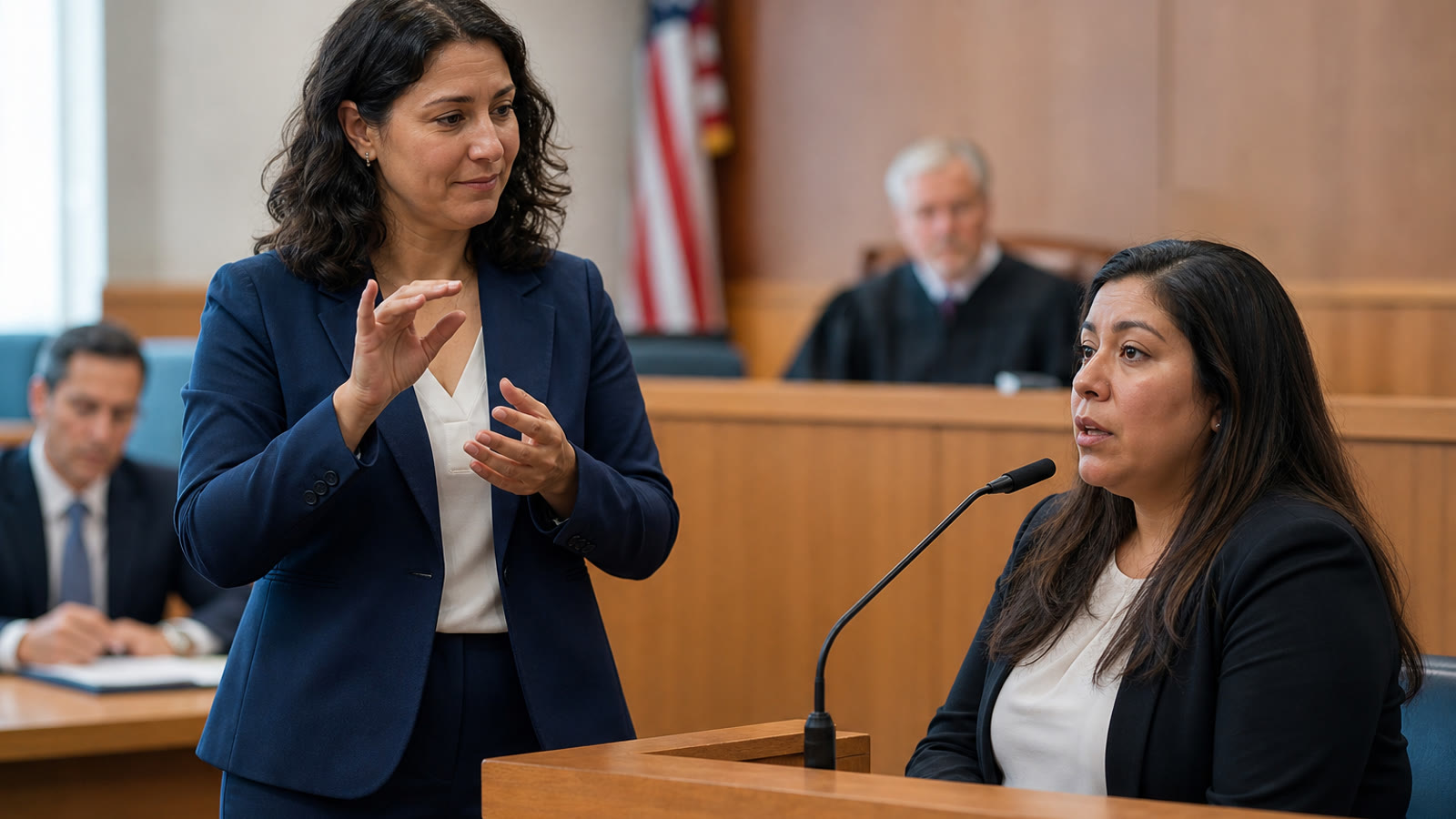
A courtroom runs on precise language. A single mistranslated word in testimony can shift the meaning of an admission, an alibi, or a consent agreement, and unlike a casual conversation, there's usually no opportunity to go back and clarify what someone "really meant." That's why legal interpreting services in Sacramento exist as a distinct, credentialed profession rather than an extension of general bilingual fluency. A qualified legal interpreter renders everything said in a proceeding — including hesitations, hedges, and awkward phrasing — without softening, summarizing, or cleaning it up, because the record depends on what was actually said, not what a well-meaning bystander thinks the person meant.
The stakes are highest in criminal court, where the Sixth Amendment right to confront witnesses and understand the proceedings against you has long required interpreter appointment for limited-English-proficient (LEP) defendants and witnesses. But the same accuracy standard applies just as much in a civil deposition, an administrative hearing, or a mediation session, settings where a rushed or unqualified interpreter is far more likely to appear because no judge is actively supervising the exchange.

California's Interpreter Certification and Language Access Requirements
California doesn't treat "bilingual" and "qualified legal interpreter" as interchangeable, and neither should an attorney or business relying on one. The Judicial Council of California's Court Interpreters Program certifies interpreters in designated languages — including Spanish, Mandarin, Cantonese, Vietnamese, Korean, Russian, Tagalog, Arabic, and Portuguese — through a formal testing process that evaluates simultaneous, consecutive, and sight-translation skills along with legal terminology and ethics. For languages that don't yet have a certification exam, the state maintains a separate registration process so qualified interpreters in less common languages can still be verified and assigned to cases.
Interpreter appointment in criminal proceedings has been standard practice in California courts for decades. What's changed more recently is civil access. Under the Judicial Council's statewide Language Access Plan, courts have steadily expanded interpreter availability into high-priority civil case types — domestic violence, child custody, elder abuse, and eviction proceedings among them. A recent statewide survey found that 51 of California's 58 trial courts now provide interpreters in these civil matters, up from just 9 courts in 2015. For Sacramento families and attorneys handling family law, unlawful detainer, or elder abuse protective order matters, that expansion means interpreter access that used to be discretionary is now closer to guaranteed, provided the request is made correctly and in advance.
Sacramento's Courts, State Agencies, and the Languages They Serve
Sacramento's legal interpreting demand looks different from other California metros for a simple reason: it's the state capital. Beyond Sacramento County Superior Court's criminal, civil, and family divisions, Sacramento is home to a concentration of state licensing boards, the California Unemployment Insurance Appeals Board, and Workers' Compensation Appeals Board panels, all of which hold administrative hearings that require the same standard of qualified interpreting as a courtroom, even though they aren't technically "court" proceedings.
The languages showing up in those hearings reflect Sacramento's distinct demographic makeup. Spanish remains the most requested language by a wide margin, consistent with the rest of California. But Sacramento County is also home to one of the largest Hmong communities in the United States, with tens of thousands of Hmong American residents, making it the third-largest Hmong metro population in the country behind only Minneapolis-St. Paul and Fresno. Sacramento also has one of the largest Slavic and Ukrainian communities anywhere in the U.S., built over decades of immigration and refugee resettlement, with tens of thousands of Russian- and Ukrainian-speaking residents concentrated in the region's northern and western suburbs. Vietnamese, Cantonese, and Punjabi requests round out a language mix that a legal interpreting partner needs real bench depth to cover, not just a Spanish-language roster.
On-Site vs. Remote Interpreting for Legal Proceedings
Choosing between on-site and remote interpreting isn't just a cost decision; it's a decision about what the proceeding actually needs.
On-site interpreting puts a professional interpreter physically in the room, and it's the right call for trial testimony, plea hearings, in-person depositions, and any proceeding where a judge, jury, or opposing counsel needs to observe demeanor alongside the interpreted testimony. Being physically present also lets the interpreter manage overlapping speech, sidebar conversations, and the pacing challenges that come with live courtroom exchanges.
Remote interpreting — whether video (VRI) or over-the-phone (OPI) — has become far more common for arraignments, case management conferences, and remote depositions since California courts expanded remote appearance options. It's often the more practical choice for less common languages where an on-site interpreter isn't available locally on short notice, or for shorter administrative hearings where scheduling an in-person interpreter would create unnecessary delay. The firms that manage this well don't default to one modality; they match it to the proceeding, reserving on-site interpreting for the moments where physical presence genuinely changes the outcome.

What to Look for in a Legal Interpreting Partner
Not every interpreting vendor is built for legal work, and the difference shows up the moment a proceeding gets adversarial. When evaluating a legal interpreting partner in Sacramento, look for:
- Judicial Council certification or registration for the specific language needed, not general bilingual fluency or a certification in an unrelated field.
- Legal terminology fluency, since criminal, family law, and workers' compensation proceedings each use vocabulary that a generalist interpreter may not have encountered.
- Familiarity with courtroom and deposition protocol, including how to request clarification, flag an untranslatable term, or manage overlapping speech without disrupting the record.
- Coverage across the languages Sacramento actually needs, including Hmong, Russian, Ukrainian, and Vietnamese alongside Spanish, rather than a roster built around Southern California demographics.
- Both on-site and remote interpreting under one agency, so attorneys and court staff aren't juggling multiple vendors with inconsistent quality standards.
- Clear scheduling and confirmation practices that hold up if a hearing date shifts, which happens often in busy Sacramento courtrooms.
The Cost of Proceeding Without a Qualified Interpreter
The financial and legal exposure from skipping a certified interpreter is easy to underestimate until it shows up in a transcript. A mistranslated statement during a deposition can be used to impeach a witness later, even when the error was the interpreter's and not the witness's. A defendant who didn't fully understand a plea colloquy has grounds to challenge that plea on appeal, unwinding a case that otherwise would have been resolved. And an attorney who relies on a client's bilingual relative to interpret a consultation is building a case file on a foundation that opposing counsel can challenge the moment it matters.
Professional legal interpreting has a cost, but it's a fraction of the cost of a mistrial, a successful appeal, or a malpractice claim tied to a client who says they never understood what they agreed to. For most Sacramento firms and businesses, the real question isn't whether to budget for qualified interpreting; it's whether the current approach — informal, ad hoc, or built around whoever happens to be bilingual in the office that day — would hold up if a case actually got contested.
Frequently Asked Questions
Is a court required to provide an interpreter for a non-English-speaking party in California? Criminal defendants and witnesses with limited English proficiency have long been guaranteed a qualified interpreter in California courts. Civil access has expanded significantly in recent years, and most of the state's trial courts, including Sacramento, now provide interpreters for high-priority civil matters such as domestic violence, custody, elder abuse, and eviction cases.
What's the difference between a certified and a registered court interpreter in California? Certified interpreters have passed the Judicial Council's formal testing process for a designated language, such as Spanish or Mandarin. Registered interpreters serve languages that don't yet have a certification exam and are verified through a separate registration process. Both are recognized as qualified for court appointment in their respective languages.
Can a bilingual employee or family member interpret for a legal proceeding instead of a professional interpreter? Courts generally require a qualified, certified, or registered interpreter rather than an ad hoc bilingual party, and relying on a family member or untrained staff member creates real risk of a challengeable record, particularly in criminal and family law matters where accuracy affects the outcome.
Does Sacramento's legal interpreting demand differ from other California cities? Yes. Alongside a large Spanish-speaking population, Sacramento has one of the largest Hmong communities in the country and one of the largest Slavic and Ukrainian communities in the U.S., which means a legal interpreting partner needs meaningful coverage well beyond Spanish to serve the region's courts and state agencies.
Get Certified Legal Interpreting Services in Sacramento
Ortiz Schneider has provided legal interpreting services to California courts, attorneys, and businesses since 1999, with on-site and remote coverage across Sacramento and the rest of the state. If your firm or agency needs a Judicial Council-qualified interpreter who can hold up under cross-examination, request a quote and we'll match the right interpreter and modality to your proceeding.