Workers' Comp Interpreting Services in Salinas, CA: A Guide for Agricultural Employers
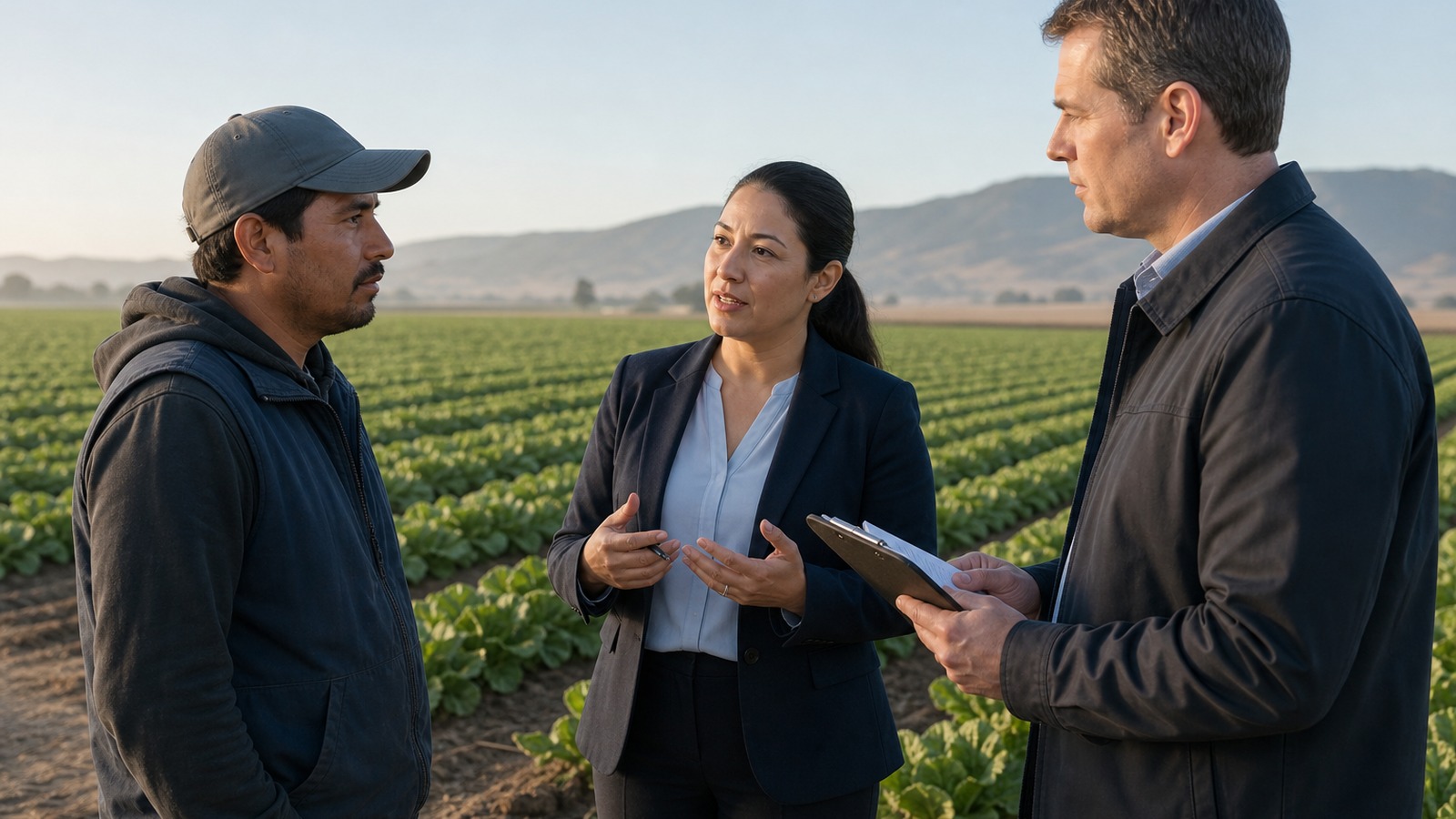
If you manage claims for a Salinas Valley grower, packing house, or agricultural staffing agency, workers' comp interpreting services in Salinas are one of the most overlooked pieces of a smooth, defensible claim. A miscommunicated symptom or a skipped interpreter at a medical evaluation can turn a routine injury into a contested case.
Quick Summary
Salinas Valley's produce growers, packers, and shippers employ thousands of Spanish- and Indigenous-language-speaking farmworkers, and a workplace injury without a qualified interpreter can stall a claim, create legal exposure, and leave an injured worker without proper care. This guide covers what California law requires for workers' comp interpreting, how the claims and QME process works, when to use on-site versus VRI interpreting on an ag worksite, and how Salinas Valley employers can build language access into their injury-response plan from day one.
Table of Contents
- The Case for Workers' Comp Interpreting Services in Salinas
- What California Law Requires for Injured Worker Language Access
- The QME/AME Evaluation Process and the Interpreter's Role
- On-Site vs. VRI Interpreting for Agricultural Worksites
- Interpreter Qualifications: What "Certified" Actually Means
- Common Language-Access Mistakes That Delay Claims
- Building a Language Access Plan Before You Need One
- FAQs
The Case for Workers' Comp Interpreting Services in Salinas
Monterey County's Salinas Valley grows a large share of the country's lettuce, strawberries, and leafy greens, and the workforce behind that output is overwhelmingly made up of Spanish speakers, along with a meaningful number of workers who speak Indigenous languages such as Mixteco, Triqui, or Zapoteco as a first language. When one of those workers is hurt on the job, workers' comp interpreting services in Salinas are what make an accurate claim, a proper diagnosis, and a fair outcome possible.
Agricultural injuries carry their own complications: repetitive strain, heat illness, equipment accidents, and pesticide exposure all require the injured worker to describe symptoms precisely, in a claims process built around English-language paperwork and terminology. A grower, packing house, or agricultural staffing agency in Salinas that treats interpreting as an afterthought risks miscommunicated symptoms, contested claims, and preventable delays in an employee's return to work.
What California Law Requires for Injured Worker Language Access
California Labor Code Section 4600 and related regulations require employers to provide medical treatment "reasonably required to cure or relieve" an injured worker from the effects of a work injury, and that obligation has been interpreted to include a qualified interpreter at treatment appointments and evaluations when the worker cannot communicate effectively in English. Title 8 of the California Code of Regulations sets out fee schedules and qualification standards for workers' comp interpreters, distinguishing "certified" interpreters (those on the Judicial Council's court interpreter list or state-certified medical interpreter registries) from "provisionally qualified" interpreters used when a certified interpreter is not reasonably available.
For claims administrators and self-insured employers, the practical takeaway is straightforward: the interpreter must be a neutral, qualified third party, not a bilingual coworker, supervisor, or family member. Using an untrained bilingual employee to interpret a medical exam can taint the record, create a due-process problem if the claim is later disputed, and put the employer at risk of a penalty for failing to provide required language access.

The QME/AME Evaluation Process and the Interpreter's Role
Most contested Salinas Valley agricultural claims eventually involve a Qualified Medical Evaluator (QME) or, where both sides agree, an Agreed Medical Evaluator (AME). These evaluations produce the medical-legal report that determines causation, disability rating, and future treatment, which means the interpreter's accuracy directly shapes the outcome of the claim.
A qualified interpreter at a QME or AME appointment does more than translate word for word. They convey tone, hesitation, and pain descriptions faithfully, flag when a term does not have a direct equivalent (a common issue with Indigenous-language interpretation, where medical vocabulary may not exist in the same form), and maintain strict neutrality so the evaluator's findings reflect the worker's own account. Scheduling a certified interpreter for every QME/AME appointment, confirmed in advance and matched to the worker's specific language or dialect, is one of the most effective steps a Salinas employer or third-party administrator can take to keep a claim on track.
On-Site vs. VRI Interpreting for Agricultural Worksites
Salinas Valley's fields, cooling facilities, and packing lines present different interpreting needs than an office or clinic. On-site interpreting puts a human interpreter physically in the room, which is generally the right call for QME/AME evaluations, depositions, and any appointment where body language, pain behavior, or a physical exam matters to the outcome.
Video remote interpreting (VRI) works well for lower-stakes moments: a same-day post-injury intake call, a check-in with a claims adjuster, or a follow-up appointment where connectivity at the clinic is reliable. VRI is faster to schedule and often more affordable, but it depends on a stable signal, and rural stretches of the Salinas Valley do not always have it. Employers should treat VRI as a complement to on-site interpreting, not a full substitute, and confirm which format a given appointment calls for before the worker shows up.
Interpreter Qualifications: What "Certified" Actually Means
Not every bilingual person is a qualified workers' comp interpreter, and the distinction matters legally as well as practically. In California, "certified" generally refers to interpreters who have passed the Judicial Council of California's court interpreter certification exam or hold recognized medical interpreter credentials; "registered" interpreters have met a lower bar for languages without a certification exam available, which is common for some Indigenous languages spoken in the Salinas Valley. Employers should ask their interpreting agency which credential applies to a given language and worksite need, rather than assuming any Spanish speaker on staff can fill the role for a formal medical or legal appointment.

Common Language-Access Mistakes That Delay Claims
A few recurring mistakes show up again and again in Salinas Valley agricultural claims:
- Using a supervisor or coworker to interpret at the initial injury report, which can create inconsistencies between the informal account and the formal medical record.
- Booking a Spanish interpreter for a worker whose first language is Mixteco or another Indigenous language, resulting in a technically bilingual but practically ineffective session.
- Waiting until the QME appointment to arrange an interpreter, rather than confirming the language and dialect during initial claim intake.
- Relying on VRI in areas with unreliable connectivity, which can derail a scheduled evaluation and push the claim timeline back weeks.
Each of these is preventable with a claims-intake process that identifies the worker's language and preferred interpreting format on day one, rather than after a problem surfaces.
Building a Language Access Plan Before You Need One
The Salinas Valley growers and packing operations with the smoothest workers' comp claims tend to share one habit: they set up their interpreting relationship before an injury happens, not after. That means having a vetted on-site interpreting partner on call, a clear process for identifying a worker's language at hire or at injury report, and a standing relationship with an agency familiar with workers' comp procedures specifically, not just general business interpreting.
Ortiz Schneider works with growers, packing houses, and staffing agencies across the Salinas area to schedule certified interpreters for QME and AME evaluations, depositions, and treatment appointments, in Spanish and in the Indigenous languages common to the region's agricultural workforce. Requesting a quote before your next claim comes in is the simplest way to make sure an interpreter is never the reason a case gets delayed.
FAQs
Does a California employer have to pay for a workers' comp interpreter? Yes. Under California law, the cost of a qualified interpreter for medical treatment and evaluation appointments tied to a work injury claim is the employer's or claims administrator's responsibility, not the injured worker's.
Can a bilingual coworker interpret for an injured farmworker instead of hiring a professional? It is not advisable for formal appointments such as QME/AME evaluations or depositions. A neutral, qualified interpreter protects the accuracy of the medical-legal record and avoids the appearance of coaching or conflict of interest that can arise with a coworker or supervisor.
What if a Salinas Valley worker speaks an Indigenous language rather than Spanish? Ask the interpreting agency to confirm the specific language and, where relevant, dialect. Mixteco, Triqui, and Zapoteco are not interchangeable with Spanish or with each other, and matching the wrong language to the appointment can invalidate the interpretation.
How far in advance should we schedule an interpreter for a QME appointment? As soon as the appointment is set. Certified interpreters for less common languages and Indigenous dialects can require more lead time to schedule than Spanish, so early notice reduces the risk of a rescheduled evaluation.