VRI vs. On-Site Interpreting for Workers' Comp Claims: Costs, Compliance, and When to Use Each

For claims administrators and case managers handling workers' compensation claims in California, language access is not optional — it is a legal requirement. When an injured worker speaks Spanish, Mixtec, Punjabi, Vietnamese, or any of the dozens of languages prevalent in California's agricultural, construction, and manufacturing workforce, the claim cannot move forward without qualified interpretation.
But the question has grown more complex: which type of interpretation is appropriate? Video remote interpreting (VRI) has become widely available and is frequently positioned as a cost-saving alternative. On-site interpreting has been the traditional gold standard but involves scheduling lead time and travel logistics. The right answer is not simply one or the other — it is a matter of matching the method to the context.
This guide walks through the practical and regulatory considerations that should drive your decision-making on every workers' comp file that involves a limited-English proficient (LEP) worker in California.
What the California Workers' Comp System Actually Requires
California Labor Code § 4600 entitles injured workers to interpreter services at medical appointments as part of authorized medical treatment — at no cost to the worker. The Division of Workers' Compensation (DWC) and the Workers' Compensation Appeals Board (WCAB) have consistently affirmed this right across decades of case law.
DWC Administrative Director Rule 9795.1 governs interpreter fees and qualifications in the workers' comp system. It specifies that interpreters must be:
- Certified by a recognized body, or — for languages where no certification exists — demonstrably qualified through other means
- Fluent in both English and the injured worker's primary language
- Neutral and impartial (not a family member, treating physician's staff, or anyone with a conflict of interest)
Critically, the regulations do not prescribe a delivery format. VRI and on-site interpretation are both legally permissible. However, the standard of care — and the risk exposure — differs significantly based on appointment type.
VRI for Workers' Comp: When It Works Well
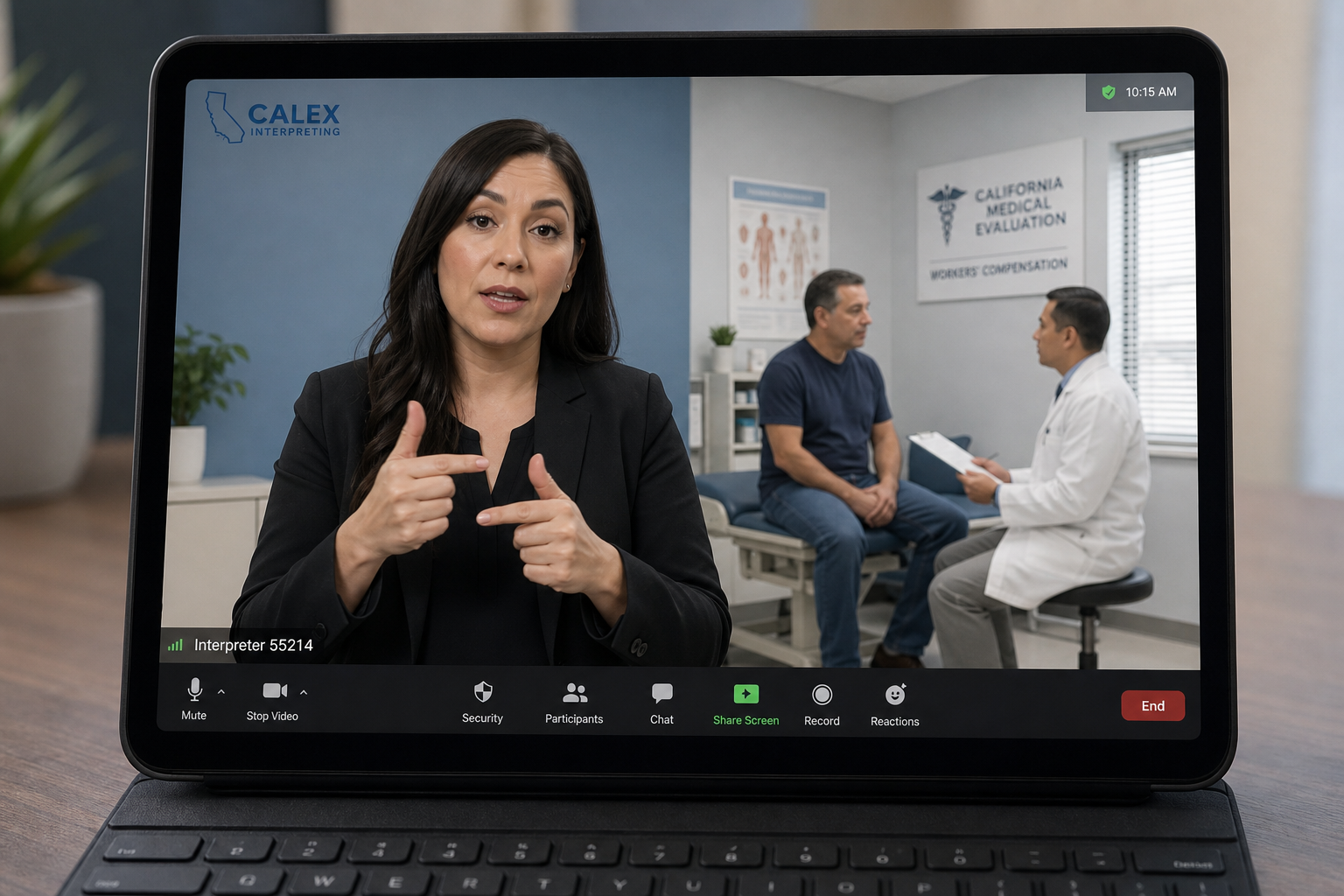
Video remote interpreting connects a qualified interpreter via a secure video platform — typically accessed on a tablet, laptop, or dedicated VRI cart — in real time. For many routine workers' comp touchpoints, VRI is an efficient and fully adequate solution.
Best-Fit Scenarios for VRI in Workers' Comp
1. Treating Physician Appointments (Primary Care, Specialist Visits)
For standard medical treatment visits — primary care check-ins, specialist consultations, physical therapy progress reviews — VRI performs well. The conversation is typically structured (chief complaint, treatment update, medication review), the duration is predictable, and physical document review is minimal.
VRI is especially practical in California's Central Valley, where workers' comp claims often originate in rural areas like Kings County, Tulare County, or Merced County — geographies where finding an on-site interpreter with same-day availability can be genuinely difficult. A certified VRI interpreter can be connected within minutes.
2. Telehealth Evaluations
As telehealth has become mainstream in post-2020 California healthcare, many treating physicians now conduct follow-up appointments via video. In these environments, VRI integrates naturally — the interpreter joins as a third participant in the video session. HIPAA-compliant VRI platforms support this format seamlessly.
3. Case Management Check-Ins and Nurse Case Manager Visits
Telephonic or video-based case management calls to assess an injured worker's progress or coordinate care are ideal VRI use cases. These conversations are conversational rather than testimony-based, and the stakes of any single session are lower than a formal evaluation.
4. UR/IMR Coordination Calls
Utilization review and independent medical review coordination calls involving an LEP worker can be handled via OPI (over-the-phone interpretation) or VRI without compromising the process.
VRI Cost Advantages
VRI is typically billed at a lower hourly or per-minute rate than on-site interpreting, with no travel time or mileage component. For a claims administrator managing a high volume of Spanish-language files across Southern California — Los Angeles, Orange County, San Bernardino, Riverside — the cost savings on routine appointments can be substantial over the life of a claim.
However, cost should never be the sole driver when VRI is not the appropriate modality. A poorly interpreted deposition, for instance, can cost far more in litigation than the savings from avoiding an on-site interpreter.

On-Site Interpreting for Workers' Comp: When It's Non-Negotiable
On-site interpretation means a qualified interpreter is physically present in the same room as the injured worker, the physician, the attorney, or the hearing officer. For high-stakes workers' comp proceedings, the physical presence of a certified interpreter is not merely preferable — it is often essential to the integrity of the process.
Best-Fit Scenarios for On-Site Interpreting in Workers' Comp
1. IME and QME Evaluations
As we covered in our guide to IME/QME interpreting in California workers' comp, these medical-legal evaluations directly determine the degree of permanent disability and future medical treatment. An injured worker must be able to fully communicate a detailed medical history, describe the mechanism of injury, and respond accurately to the evaluating physician's questions.
VRI at a QME evaluation introduces real risks: screen glitches, connectivity drops, poor audio quality in a medical exam room, and the inability to pick up on nonverbal cues or physical demonstrations of pain. The WCAB has found in multiple cases that technology failures that impair communication can constitute grounds for reopening an evaluation. On-site interpretation eliminates these variables.
2. Depositions
Depositions in workers' comp litigation require simultaneous or consecutive interpretation of spoken testimony that will become part of the official record. Defense attorneys and applicant attorneys both have a right to an accurate record. The interpreter may need to handle objections, complex legal terminology, medical nomenclature, and rapid back-and-forth exchanges.
California attorneys handling WC depositions in Los Angeles, the Bay Area, or the Central Valley consistently request on-site interpreters for this reason — and they are correct to do so. An interpreter participating via a small screen in a conference room is at a significant disadvantage in a deposition setting.
5. WCAB Hearings
The Workers' Compensation Appeals Board — with district offices in Los Angeles, San Francisco, Oakland, Fresno, San Jose, Bakersfield, Salinas, Santa Barbara, and across the state — requires in-person interpretation for most formal hearings. The Board's procedures presuppose physical presence of all participants, including interpreters. Remote participation is the exception, not the norm.
6. Field Investigations
When a claims investigator or defense representative conducts a recorded statement with an LEP worker — particularly in agricultural settings in Salinas, Oxnard, or the Central Valley — on-site interpretation preserves accuracy, reduces the risk of misunderstanding, and ensures the worker's rights are protected. A recorded statement obtained through inadequate phone interpretation is a litigation liability.
7. Workers with Hearing Impairments or Language Complexity
Injured workers who are deaf or hard of hearing require in-person ASL interpreting for virtually all substantive appointments. Similarly, workers who speak indigenous languages — Mixtec, Zapotec, Triqui — often require interpreters with dialectal proficiency who work better face-to-face, particularly with elderly workers or those with limited literacy who rely heavily on nonverbal communication to confirm comprehension.
Side-by-Side Comparison: VRI vs. On-Site for Workers' Comp
The Compliance Risk Nobody Talks About
California workers' compensation defense attorneys and claims professionals are increasingly aware of a litigation exposure that rarely gets discussed in the context of VRI: the risk that a VRI session will be challenged after the fact.
If an IME or deposition produced via VRI results in a disputed finding — and the injured worker's attorney can establish that the interpreter was functioning through a degraded connection, that the worker could not see the interpreter clearly, or that the interpreter missed nonverbal cues — the evaluation or testimony may be challenged for inadequacy of language access.
This is not hypothetical. California workers' compensation law requires that language access be meaningful, not just technically present. Claims administrators who default to VRI for all appointments to reduce costs are creating a portfolio-level litigation risk that can far exceed the short-term savings.
The practical guidance: use VRI strategically for routine appointments where the stakes are lower and tech failure is recoverable. Invest in on-site interpreters for any appointment that produces a record — depositions, IME/QME evaluations, WCAB hearings — and for any appointment where the worker's ability to fully communicate is the difference between a valid and invalid proceeding.
A Note on Language Availability Across California
One of the most underappreciated factors in the VRI vs. on-site decision is language availability. For major language pairs — Spanish-English, Vietnamese-English, Tagalog-English — VRI platforms can source certified interpreters quickly. For the languages that California's agricultural workforce actually speaks — Mixtec dialects (Mixteco Alto, Mixteco de la Costa), Zapotec variants, Triqui, and others — VRI platforms often cannot staff adequately.
In the Salinas Valley and Central Valley, where Mixtec-speaking farmworkers make up a meaningful portion of the WC claimant population, on-site interpreters with genuine community fluency are not interchangeable with general-language VRI platforms. Ortiz Schneider's network of California-based linguists includes interpreters with these language capabilities — available for on-site assignments in Salinas, Watsonville, Fresno, Bakersfield, and across the Central Valley.
Frequently Asked Questions
Is VRI legally compliant for California workers' comp appointments?
Yes — California law does not require a specific delivery format. Both VRI and on-site interpretation can satisfy the language access requirement under Labor Code § 4600 and DWC regulations, provided the interpreter is qualified and certified, and the delivery method does not impair meaningful communication.
Can I use VRI for a QME evaluation?
Technically yes, but it is not recommended. QME evaluations produce the medical-legal report that often governs permanent disability and future medical care. Technology disruptions, poor audio, or an inability to observe nonverbal cues can produce an incomplete evaluation and create grounds for dispute. On-site interpretation is the standard of care for IME/QME appointments.
Does the injured worker have a right to choose between VRI and on-site?
The injured worker has a right to qualified language access — the delivery method is generally the claims administrator's or medical provider's decision, but it must be adequate. If an injured worker objects that VRI is inadequate for their communication needs (e.g., due to hearing or vision impairment, or limited technology literacy), that objection should be taken seriously.
How far in advance should I book an on-site interpreter for a WC appointment?
For Spanish and common language pairs, Ortiz Schneider can typically accommodate requests with 24–48 hours' notice. For indigenous languages, specialized dialects, or high-demand markets like Los Angeles, 72 hours or more is advisable. For depositions and IME/QME evaluations, booking at least one week in advance is best practice.
Does Ortiz Schneider provide both VRI and on-site interpretation for workers' comp?
Yes. Our team provides certified on-site interpreters and VRI/OPI remote interpretation for workers' compensation claims throughout California. We advise claims administrators on the appropriate modality for each appointment type — and we provide coverage in Spanish, Vietnamese, Tagalog, Punjabi, Cantonese, Mixtec, and 200+ other languages.
Working with Ortiz Schneider on Workers' Comp Claims
Ortiz Schneider has served California's legal, insurance, and workers' compensation communities since 1999. Our linguists are certified, vetted for industry-specific terminology, and available for both on-site assignments — including in Salinas, Fresno, Bakersfield, Los Angeles, and the Bay Area — and VRI/OPI engagements.
Our team understands the workers' comp workflow: we work with claims administrators, defense attorneys, applicant attorneys, nurse case managers, and QME physicians. We know what a well-run IME appointment looks like, and we know the difference between a routine follow-up visit and a proceeding where the stakes require a certified interpreter in the room.
If your firm or claims unit handles a significant volume of LEP workers' comp claims in California, we invite you to speak with our team about building a reliable language access protocol — one that uses VRI strategically where it works, and on-site interpreting where it matters most.
Ready to build a smarter language access program for your California workers' comp claims? Request a quote or contact our team to discuss your needs.